Sunday, October 23, 2016

Tusheti - a beautiful place you've never heard of

We recently returned from a hiking trip to Georgia (the country, not the state). We had gone expecting great mountain hikes; we found the closest thing I've yet seen to Shangri La. This post, quite unlike the rest of the blog around it, tells about the remote and fascinating Tusheti area in north east Georgia, and why you want to go there.
Tusheti is the green corner north-north-east of Tbilisi.

To reach Tusheti you travel to Tbilisi, the center of which is a jumble of churches, castles, ultra-modern structures, and communist era monstrosities. The overall feeling is post-communist, even though it's been 25 years since Georgia achieved independence from the Soviet Union. I didn't see many traffic lights, nor drivers who seemed to miss them, but there was WiFi.

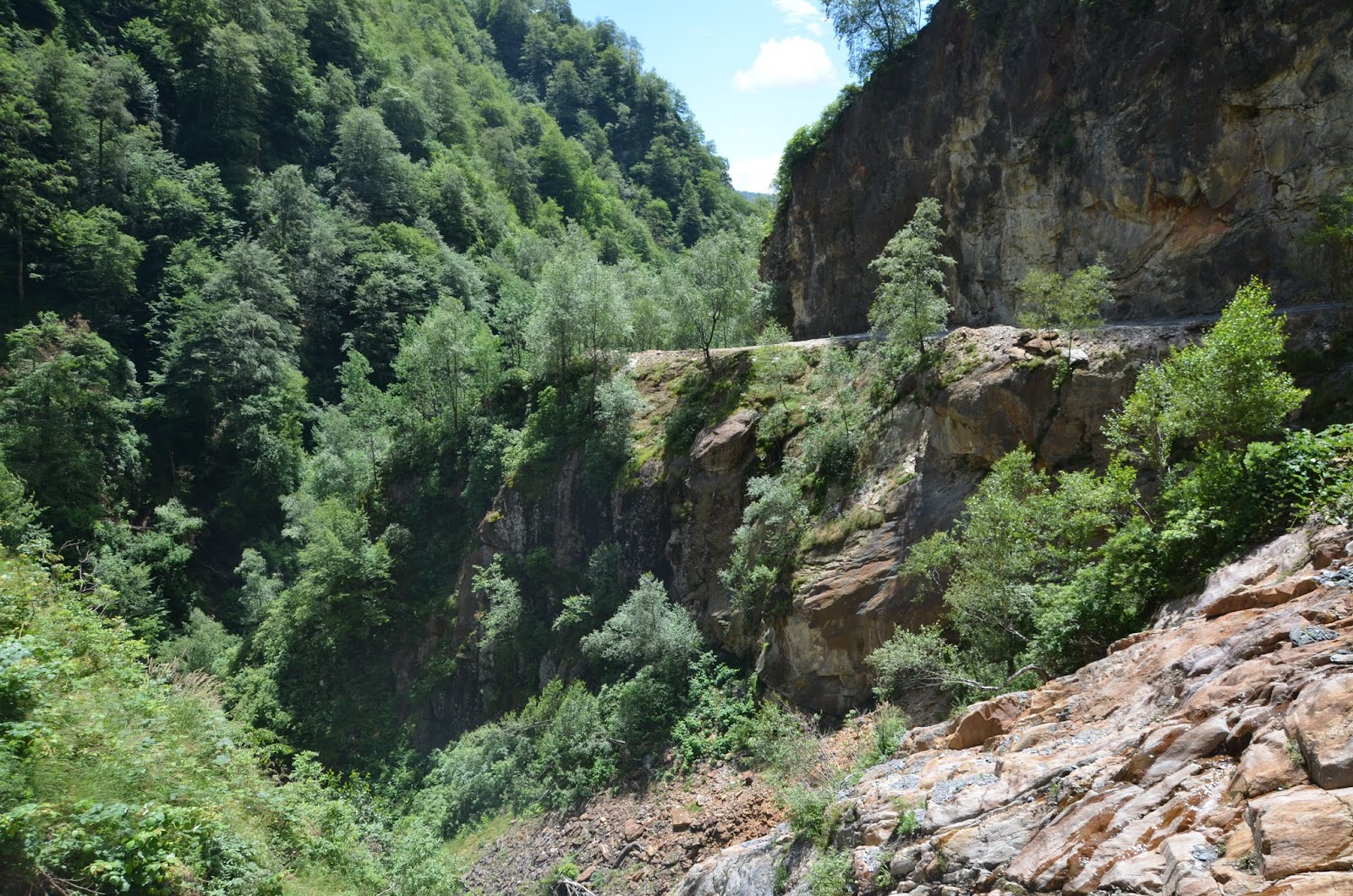
The next morning it was off to the mountains. For about two hours we traveled on reasonably paved roads through rural areas that looked even more post-communist than Tbilisi. Then the road petered out, and we were on gravel. Then the gravel became narrow, and then there was a rapid river beneath us, and then even the river disappeared, to be replaced by treetops in the gorge below us. Quite a way below us. It dawned on us there was a reason our guide had mentioned a full day travel – not that it was so far but that the road was for inching along. Many hours of inching along.


Mostly without a security railing.

 Eventually we reached the pass at the top of the road.


 And then we went down the other side, then up again. 72 km of unpaved mountain road, alongside a chasm almost the whole time, and no sign of human settlement anywhere. Until eventually we arrived in Tusheti.


So the first thing you need to know about Tusheti is that it's beautiful, but the second is that there's only one single road into it (and back out), and it's not one you want to drive. The locals have been going up and down that pass for centuries, and they start driving it after a childhood of riding it, sometimes in big six-wheeled trucks. They know what they're doing and they don't fall off the cliff. Others sometimes do. So have a local take you up, and don't even think of doing it yourself.

Beauty is actually not the only reason to be up there, but it is a compelling one.


What makes Tusheti different from other beautiful mountain ranges are its people. The Tushetis. There are a few thousand of them, and they've been there for at least 1,600 years. They've got their own dialect. They're spread over the slopes of four valleys, surrounded by 5,000 meter mountains. The winters are ferocious, so they spend them in the lowlands, migrating up for the warm half of the year with their cattle, horses, and many sheep. They also raise crops, though with the advent of four-wheel-drive pickup trucks they've been focusing more on livestock and cheese-making, importing the rest from below. 

The rest of Georgia has been changing political overlords incessantly for as long back as memory goes; Tusheti, secure behind that rampart of mountains, only twice, once by Tamarlane. Even the Greek Orthodox Church, present everywhere else in the country, had a hard time making it up the pass, and to a surprising degree never fully made it: the Tushetis till this very day, are polytheistic. They're Orthodox and also pagans, simultaneously. There are more than 50 small villages and hamlets in Tusheti; only three have churches, and even they are built alongside the sacrificial altar that most of the villages have. Both are active.


Only in one village - Dartlo - was the church constructed on the site of the altar, rather than alongside it. A few decades later there was an earthquake and the church was destroyed. This is a fact, make of it what you will.

The gods, by the way, are apparently two sets of dieties, one benign and the other malicious, and the Tushetis appeal to the benign ones for protection.

Today's Tushetis all come together for their annual holiday in August, where they offer sacrifices and celebrate, then they break up into subgroups by valley, and continue with local sacrifices and celebrations. Even those who no longer make their living from the land and don't spend the whole summer in the mountains, come up for the month of celebrations. Thus, the slight ghost town sensation visitors can have in some of these villages must be greatly reduced in August.

Not fully however. If a family ever runs out of male descendants, the family home will be abandoned; it is now accursed, not to be used ever again. Each village has a few "dead' homes, slowly disintegrating. Another ancient tradition is that woman may not approach the altars, nor the stills where ritual beer is prepared. If you wish to respect the locals, when entering a new village you'll ask where not to go; the locals will appreciate your sign of respect.


On the way up that pass I'd noticed a few rusty pylons.


What are those about, I asked our guide, as we walked between villages unadorned by any electric poles? The Soviets, she said. The Soviets were against the Tusheti way of life. So they forbade families to come up each summer, but insisted the menfolk do; each one was assigned a production quota of livestock or cheese. This was so important that even during WW2, when the Soviet Union was in a state of total war, the Tusheti men were left alone to fill their quotas. They were administered from Omalo, the "big city" (population 812, if you ask me), near the entrance from the road over the pass. The administrators got electricity. And then, I asked? As soon as the Soviets left, she said, some locals stole the lines and sold the metal. And yes, the other locals saw this happening, and no, no one dared stop them in the lawlessness of the time.

So the Soviets had threatened the very existence of the Tusheti way of life, but they'd left behind a (somewhat) improved road and the memory of electricity. A few years ago a Czech NGO began installing a limited number of solar panels in some of the villages, so that the guesthouses offer hot water showers early in the evening, and you can recharge your cellphone batteries – though in many cases you won't be able to make calls with them. The solar panels are 21st century progress over the long-gone electric cables of the 20th century; cellphone connectivity is a 21st century scourge, thankfully limited up in the mountains.

While the Soviet Union is gone, Russia is very close. When hiking along the Alazani River, which we did for parts of three days, it's right there, at the top of the snowy mountain ridge. To be precise, Chechnya is to the north and Dagestan to the east. During the first round of the Russian-Chechnyan war in the 1990s, Tusheti served as the back base for the Chechnyan  rebels. (There's no road across the steep ridge, but if you're in good physical shape and don't suffer from altitude sickness you can climb across it). Nowadays, so we were told, the Russians are at the top of the ridge and will shoot if anyone comes too close. Elsewhere along the border, where there's no natural line such as the top of a ridge, Russia is apparently constantly moving the border deeper into Georgian territory – not that this is anything that gets reported in the Western media.

One morning we encountered a horseman trotting along who, unlike all the other locals I met, refused my request to take his picture. Our guide explained that he's Chechen, not Tusheti; a religious Muslim. Apparently there's a handful them who have remained permanently on the gentler side of the mountain ridge.

Upon probing a bit deeper, I got the impression that spending a thousand years over the hill from the Chechans and other rough Caucasus tribes has involved a degree of friction. Cattle rustling, say, and perhaps the random clash. This would explain the impressive defense towers each and every hamlet offers. They wouldn't be much use against a Tamerlane intent on destruction, nor against Soviets intent on re-inventing society, but for offering sanctuary until the cattle rustler moved on, they were fine. For tourists with cameras they're great.


Don't let the towers fool you, however. These are not the castles of the aristocrats, built by the serfs. Throughout its many centuries, even as the Europeans to the west had rule by the few over the many, the Tushetis lived in a mostly egalitarian society. Success at farming was important, but each tribe or village demanded of each family that they work hard enough to succeed, with no allowances for slackers. Some wise old men were consulted for being wise, and in the village of Diklo we saw the remains of an ancient court of peers which resolved local disagreements. No one was truly rich, so no-one was poor, either. Sounds as close to being free as most of history had to offer, and you had to come all the way to this remote corner of the Caucasus to find it.

One of the major products of the area is Tusheti cheese, famous, apparently, throughout the country and beyond. One day we asked to see the process close up. Of course, said the cheese-maker; by all means.


On Shabbat we didn't do any hiking; yet simply sitting in the small village of Girevi was instructive: the villagers were busy. Laundry is done by hand. Wood is chopped by hand. Cows are milked by hand. Goats are slaughtered on the track next to the hut, then quartered and processed, all by hand. Three men down the lane spent the whole day putting a new roof above a veranda, apparently preparing a new guest house. The horses need tending.

The houses the Tushetis live in are rough hewn (a stronger word than 'rustic'). Sometimes there's a solar panel; every now and then we saw satellite TV receptors, almost always disconnected. There are no paved roads. I assume they've got running water since that's easy to have, simply by running a pipe from a nearby stream. They often own a battered second-hand van or pickup truck, but quite a few travel by horse, often bareback. Riding at night, our guide assured us, was never dangerous, unless one be lulled by a local evil spirit to leave the track; it wasn't entirely clear how serious she was.


They are hospitable. One day the most elder member of our party was tired, and the first vehicle that passed immediately took him and his daughter a few miles down the track to the next village. When we arrived it turned out that two young mothers with small children, whose husbands were afield, had taken them into their living room/dining room/kitchen; when we came by they welcomed us in too, so that we could have our lunch in the shade (it was a hot day). Who ever heard of such behavior in our modern world?

The most striking thing about their life style, so far as I could see, was the joy with which they gather together each evening and sit around talking and laughing. It's a hard life, physically, and a meager one financially; yet again and again, in different villages, I was impressed how they'd sit and laugh.

They're probably at a historic crossroads. In past centuries when they felt a mountainside was overgrazed they'd dedicate it to the local spirit of the mountain, so it became forbidden for grazing, and Nature would retrieve it. Hunters asked for the blessing of the Goddess of Hunting, but were careful not to anger her by harming young females and their offspring, thus ensuring sustainability. Hunting is no longer essential, and even grazing is slowly declining; more Tushetis come up for the month of August than for the entire season. What is rising, slowly and tentatively, is tourism. Being the sparely inhabited land it is, tourists inevitably have an impact, and leave a footprint. In the most remote villages we reached, at least one or two families had put up a primitive sign declaring their guest house or restaurant (fare: meat, cheese, simple vegetables, local bread, Georgian beer brought up from the lowlands in large jars, and Chacha, the national (very) alcoholic liquor. This young man and his wife and infant live in a hut and graze their flock; and they've put up a sign declaring it to be a café.


Given the remoteness, that challenging road, the rusticity and the appeal of such a land only to tourists who're into roughing it in magnificent places, the locals are unlikely to be overrun anytime soon by air-conditioned busses and tourists who insist on Starbucks. Yet change is afoot, and a degree of commercialism may be inevitable. So don't wait too long.

Logistics: Our guide, Tiko Ididze, is the best you could wish for. Her English (and apparently her Spanish) is flawless, her guiding ability is high, she's knowledgeable, she's young enough to be quite free of the mannerisms communism inculcated in its citizens. Living in Tbilisi she's just what you'd expect a young Western urban professional to be… except that she's Tusheti herself. Which means she knows all of them either personally or to the second degree, knows all of their history and is generally a trove of information. I don't generally do advertising on this blog, but if this post has done anything to convince you, talk to Tiko. Tinikoididze at Gmail.

Finally, a word about our group: we were organized by Yedidya and Susan of Koshertreks. If you're into hardworking treks in fantastic remote places, and you care deeply or at least don't mind kosher food while being there, Koshertreks is an outfit you should know about.


Friday, October 14, 2016

A Hassidic athiest Chabad socialist folk song

One of the notable sections of the service on the evening of Yom Kippur is Kachomer Beyad Hayotzer, Like clay in the hands of a creator. After the service this week our Rabbi, Rav Benny Lau, told us the startling tale of the melody and its second career. Anyone who knows Israeli culture and has gone to an Ashkenazi synagogue on Yom Kippur ought to have noticed it; but I don't know many folks who have. I certainly hadn't.

Kachomer seems to have been written - words and melody - by Shalom Charitonow, a Chabbadnik in the early 19th century. Or not. I've seen different versions (the Internet can be a confusing place) as to whether Charitonow wrote the words, or perhaps merely the melody, and then the two were connected only in the 20th century in Israel. In any case, they've been connected for decades, if not centuries.

Charitonow lived in Nikolayev, a shtetel in what today is the Ukraine. Many years later another young Jew from Nikolayev, Emanuel Novograbelski, was about to be sent to exile in Siberia for his Zionist leanings, but instead was exchanged with the British for some Russians who'd been arrested in Manadtory Palestine; so in the mid 1920s he arrived here and joined the pioneers. He even joined the Labor Brigades for a while until his health forced him to be a city-dweller. Even then, however, he joined the Haganah, and the events of Summer 1929 found him serving with his unit in Tel Aviv. And that's where he was when news of the birth of his first son reached him.

Flushed with the personal excitement of being a new father, and the national tension of the first major round of Jewish-Palestinian violence, Emanuel, who by now was mostly known by his pen name Emanuel the Russian (because he wasn't one?) wrote a lullaby for his son: Sleep son, your mother is with you, tomorrow there's lots of work to be done, the fields at Beit Alpha are burning, one must never never succumb to despair, sleep son sleep son sleep. Lacking the time to compose a melody, he borrowed a niggun from the Old Country.

And ever since the tune has had two separate lives. If you're aware of the Israeli cannon of songs, Shirim Ivri'im, you'll know Shchav bni - rest, my son, as an early part of the culture. If you've ever gone to an Ashkenasi shul for Kol Nidrei evening, irrespective of Hassidic or Misnagdic, you'll know Kachomer Beyad Hayotzer. And if you're both (some of us are), you'll recognize both, but never both at the same time. Or rather, both as being the same thing.

Here's the melody:


Here's Arik Lavie, an important performer of cannonical songs, demonstrating how basic this one is:

 Here's a band of chabadnicks doing it the Chabad way:

Here's Aya Corem, demonstrating that young contemporary singers still hold the early parts of the cannon to be their own.


 Finally, here's someone who definitely knows the whole story: secular, cannonic, creative, and deeply connected Chava Alberstein, tying it all together.

Tuesday, October 11, 2016

Anita Shapira on David Ben Gurion

Anita Shapira, perhaps the single most important historian of modern Israel, has a short, new-ish biography: Ben Gurion, Father of Modern Israel, which I recently read. It's a fine way to get an overlook of his life without delving into the endless minutiae of political infighting in Mandatory Palestine, 20th century Zionism and the first few decades of the State of Israel. I came away from it with a number of new insights.

First, while Ben Gurion is the towering figure of 20-century Jewry (neither Sigmund Freud nor Albert Einstein contributed much to the history of the Jews), he wasn't clearly destined for greatness. Yes, he belonged to the near mythical generation of the 2nd-Aliya immigrants who came to Ottoman Palestine at the turn of the 20th century and formed the wellspring and leadership of Zionism for decades - but no, he played no significant role at the time. Actually, he remained mostly unknown or at least unremarkable even to most Zionists until as late as 1942, when he became a major proponent of the Biltmore Program which explicitly strove to create a sovereign Jewish State.

Second, his greatness expressed itself mainly in the decade between 1942 and 1953, when he repeatedly saw better than others both the dangers and potentials of the situation, and mostly succeeded in wrenching events in the direction he felt was best. This included wresting leadership of the Zionist movement from Chaim Weitzman, in a profound change from a political movement which sought political and diplomatic progress, to a national movement which focused mainly of facts on the ground. He recognized that the real enemies were the Arabs, not the British, and facing them would require a modern army, not a militia. He understood the need for arms to be acquired and prepared so as to arrive in Israel immediately after the British departure. He saw the historic significance of bringing close to a million Jews into Israel, even though the majority were Mizrachi Jews from the Arab world, and not the familiar Yiddish speakers from Europe, most of whom had been murdered in the Shoah, and even though the effort required of Israel's citizenry were gigantic and prolonged. And sundry other achievements.

Third, as he grew older (he was 62 when Israel was founded) he became a bit of a bore or a crank, and while he remained at the helm until 1963 (with one year off in 1953), the heroic ability to forge reality was gone. Indeed, from 1960 onward, until the end of his political career towards the end of the 1960s, he seems to have been quite an oddball, furiously feuding with his party and many others over a series of issues in which, according to Shapira, he was probably right, but who cared and why was it worth all the arguments? He reverted to a father of the nation figure only in his final, post-politics years (when we all referred to him as Hazaken, the Old Man, a moniker no-one ever thought to apply to Shimon Peres, say, who died at 93 compared to BG's 87).

Only after he left politics, and since his death, has memory of those final bitter years dissipated. Who today remembers Pinchas Lavon, say, or the Rafi party? No one under the age of 55, I'd hazard to guess, and not even most of them.

A great yarn, a fascinating story, and a wonderful opportunity for some enterprising young biographer who's willing to spend a decade or two writing a full-blown biography.

Saturday, October 8, 2016

Carmit Feintuch: A Rabbanit in Jerusalem

Just the other day Yair Rosenberg and Yedidya Schwartz published a list of interesting Israeli rabbis. One, Rabbi Benny Lau, is the Rav of the congregation to which we belong (tho I admit I go to other synagogues in the neighborhood, too). For whatever reason they omitted to mention the biggest story about him this year, the fact that he brought about the appointment of a woman as his colleague.

The Ramban congregation in the Jerusalem neighborhood of Katamon prides itself on being a mainstream orthodox synagogue with a difference. Unlike some of the congregations in its vicinity which have an agenda above orthodoxy, most famously the egalitarian Shira Hadasha, say; and unlike the many "regular" orthodox places in its neighborhood which simply do their thing with little intention to make any statements (Ohel Nechama, say, or Nitzanim, to mention two of the larger ones); and quite unlike the Erloi Yeshiva around the corner, which is solidly Ultra-orthodox - Ramban under Rav Benny thinks hard (and publicly) about what it's doing. About a decade ago we had a three-year discussion about the role of women on Simchat Torah. We never moved as far on Bat Mitzvas as some progressive orthodox shuls have. We like to tell ourselves that since we're not revolutionaries, when we do decide on some change it's because that's where the mainstream is moving to.

This year we decided to hire a woman as the Assistant Rabbi, or perhaps the Spiritual Leader, or maybe something else. There was a long complex and multi-layered process in which anyone who cared to voice an opinion was encouraged to do so, with considerable disagreement as you'd expect from any group of opinionated Jews. Till this day there is still disagreement about what the job is meant to be and how we got here; but since last month we've got Rabbanit Carmit Feintuch on the job.

Here's an interview with a fellow about the appointment;  here's Rav Benny writing about it; here's the Jerusalem Post reporting on it.

I'm here today to report on some personal initial impressions of my own, a month or so later.

First, there's the irrefutable fact that Ms. Feintuch represents something new in Jewish history: an orthodox talmida chachama. True, over the centuries there have been rare Jewish women who knew as much about the ever-growing library of thousands of books which made up the full repository of Jewish culture up until the modern era. But they were always alone in their society, if not alone in their century. Carmit Feintuch, probably 40-ish, I'd guess, is of the first generation where there's an entire cohort of highly educated women fully conversant in that library. I'm an old codger, true, but as recently as when I was younger, they didn't have those sort of women, nor the institutions where they could learn and then teach. Now we do. Young girls as eager to study all the traditional texts as their brothers, and men and woman scholars to teach them. Since books and learning are totally central to traditional Judaism, this is probably the single most important development in contemporary Judaism, a change which will reverberate for many centuries and one to be pinpointed as beginning towards the end of the 20th century.

(Well, perhaps not the single most important development: that would be the return to Israel and the creation of sovereignty. But those two were essential for this one, and all three are closely tied together).

Second, Rabbanit Carmit truly is a scholar. For lack of precedents I don't know if she's called a talmidat chachamim, or a talmida chachama; we'll have to wait and see how the language deals with the new reality. Just this afternoon I found myself arguing with a fellow congregant about the lecture she gave this morning, as to how learned she is - the mere fact of the discussion proving my point, as my interlocutor wasn't saying she's not learned, but rather he was kvetching that she wasn't using her knowledge to best effect. I decided not to plea for his patience by saying that she's only been at it for, what, 20 years, and her entire group not more than 30, while the menfolk have been at it for 2,000 - because that would have weakened my position. As recently as 15 years ago it would have been inconceivable for me to have a discussion with a rather conservative-minded orthodox man critical of a woman scholar for not being as totally in control of her Torah materials as any other rabbi.

Finally, the most interesting thing about Rabbanit Carmit's talks before the congregation are not that she knows so much, but the way in which being a woman and a mother (of six) seem to give her a different perspective on the same texts. The other day she took a refrain often used in the Rosh Hashana service - Hayom Harat Olam - and built her talk around the obvious but often-overlooked fact that the words mean, literally, this is the day of the conception of the world. Though she never said as much, conception is a thing women can talk about better than men. She simply demonstrated it, by talking about theological aspects of conception. This morning both she and Rav Benny, in two separate talks, took note of a rather minor aspect of Yom Kippur, a miracle whereby a red cord in the Temple used to turn white at the climax of the day's service. He used this to talk about social matters; she used it to talk about the personal ability to reach for communication with God.

Perhaps the novelty will wear off. Perhaps it's not a woman thing at all, merely a Carmit thing. It's early days, and I don't know how all this will appear a year later, or three. Yet no matter how things play out at the Ramban synagogue in Katamon, there's some major change afoot. The traditional Jewish conversation in those 30,000 books has been going on for more than 2,000 years; bringing into it the half of the community which wasn't part of it cannot but change its tone and content in unpredictable but significant ways. At the very least, it will be a richer conversation.

Sunday, July 3, 2016

National sovereignty: the very first thing Jews did with it

The Brits just upset everyone by voting to put their sovereignty above their obvious economic well-being. Or maybe it was something else. I admit I don't know what they were thinking with their Brexit vote, and unlike most pundits, I don't have the foggiest notion how the decision will look a year from now, a decade from now, or 25 years from now. (I chose the word foggy advisedly).

It just so happens, however, that over the Brexit weekend I was struck by a thought I hadn't previously had about the time the Jews reclaimed their sovereignty after some 2,000 years without it. Recently I completed the reading of Zeev Shaerf's classic book "Three Days" (written in Hebrew in 1958), describing May 12, 13 and 14 1948.  The book looks at the battlefields of the final three days of the British Mandate in Palestine; at the first engagement of a formal Arab army (Transjordan's British-led Arab Legion) in the campaign to prevent a Jewish State, and the last-minute half-hearted attempts by the international community to stave off a war by preventing the creation of Israel; at the political and administrative efforts of the Yishuv to launch an independent state; and many other things that were crammed into those last three days.

The British Mandate was to terminate at midnight between May 14th and 15th. As the date approached, the Jews realized they had to declare their sovereign nation then, or perhaps never. Then, however, would have been the night between Friday and Saturday. Declaring the state on the Sabbath wasn't an option, so the declaration was brought forward till Friday afternoon, technically eight hours before the end of British rule.

It's hard for us today to remind ourselves how momentous a decision it was. Declaring Jewish sovereignty for the first time in some 2,000 years; and declaring sovereignty at a moment of intense international confusion and tenacious Arab determination to destroy the new State before it managed to find its feet and begin to function, killing as many Jews as it might take.

Yet even before doing all that was the decision to respect the Sabbath by not waiting for the official end of the Mandate. Zionism, a movement of mostly secular Jews who had given up on the religious project of waiting for the Messiah, chose to respect the Sabbath as its very first act of sovereignty.

Friday, June 24, 2016

Brexit and the Jewish Question

Back in 2003 Tony Judt, an otherwise important historian, took to the pages of the New York Review of Books to explain why Israel was destined to disappear:
The problem with Israel, in short, is not—as is sometimes suggested—that it is a European “enclave” in the Arab world; but rather that it arrived too late. It has imported a characteristically late-nineteenth-century separatist project into a world that has moved on, a world of individual rights, open frontiers, and international law. The very idea of a “Jewish state”—a state in which Jews and the Jewish religion have exclusive privileges from which non-Jewish citizens are forever excluded—is rooted in another time and place. Israel, in short, is an anachronism.
The part about exclusive privileges etc was of course always nonsense, as the good professor knew perfectly well even at the time. The part about the end of nationalism in favor of all that international verbiage could, if you squinted hard enough, just have seemed plausible enough for an ivory-tower academic to have toyed with its implications.

A mere 13 years later it seems the announcements about the death of nationalism may have been a bit exaggerated and premature, and the celebration of the international world order of border-less communities of gooey-eyed-human-rights-and-general-nirvana was, well, totally wrong. It didn't take 13 years, either; Judt's thesis was always wrong but it's been glaringly so for a number of years already.

Which brings me to a second and related point. About the time Judt was being celebrated by the NYRB readers for his prescience and courage of his opinions, it was rather common for European intellectuals and Left-wing Israelis to dangle the prospect of EU membership in front of Israelis and Palestinians who were stubbornly not behaving well. Any number of times I was asked by well-meaning European colleagues (many of them Germans, because those were the folks I often dealt with in those days) if we didn't think that making peace would be an excellent step towards Israel joining the EU. They always meant well, my interlocutors, and were proud of themselves for offering us such a valuable prize; surely I would appreciate the great honor and recognize the advantage of relinquishing a handful of anachronistic habits and geographic baggage. I always thanked them for their sentiments but said I could think of no reason why, after 2,000 years without sovereignty, we would straightaway chuck it out. Invariably they were a bit offended though I assured them no offense was intended.

Some decisions made by one generation will form the world in which  following generations live their entire lifespans.  The terms of peace which Israelis and Palestinians will someday agree on will be like that: they'll create borders and conditions which will be solid for a very long time (assuming the peace holds). Creating a viable and long-term peace will be sufficient justification for those arrangements; adapting to a passing historical fad is neither a justification nor a motive. Imagine if in 2002 Israel had agreed to jettison its interests in the name of being part of the Zeitgeist of the future, without waiting to know if that particular future would happen.

(PS. Tony Judt died a few years ago and didn't live to see the Arab 30-years-war, nor the collapse of freedom of movement in the EU, nor tens of thousands of refugees perishing just outside its locked borders, terrorist forcing curfews in European capitals, the rise (so far) of Donald Trump, nor, obviously, Brexit. Yet before he died I made my peace with him and we even had a cordial e-mail exchange. He was a fine historian even if a poor pundit).

Tuesday, June 14, 2016

Politics and wars are about emotions

Bernie Sanders never made much sense. He may have had appealing ideas about some of the wrongs of American society, but the rational numbers of his proposals never added up, and you didn't need to be an economist to know it. Yet he racked up, what, 12 million votes? Quite a number.

Trump doesn't make any rational sense, not if you keep in mind the extreme complexity of running the United States and being the single top figure in international politics. Yet here he is, the presumptive nominee of the Republican party, which, like it or not, is one of the most important political parties in the world and in history, along with the Democrats. Observed rationally, there's no contest between Trump and Hillary Clinton. Yet given the numbers of votes cast, clearly there is.

The idea of Brexit is ridiculous. There's more or less total unanimity among economists that the UK leaving the EU would be a bad idea, one no sensible person would entertain for more than 3-4 minutes if it was early morning and they were still a bit groggy. Yet so far as we know, the voters of Britain are about to vote to leave, just next week, a prospect the polls are now giving more than an even chance of happening. (UK polls, as in other countries, can be seriously wrong).

Most people don't vote because of the numbers. Not on the Left, not on the Right. They vote mostly for emotional reasons of one sort or the other. That's in the venerable and functional democracies, of which the UK and USA are the two sizable oldest. So they can't be swayed by rational arguments, either. Marketing 101 will teach you that, and if it doesn't, go to sales 101.

All of which is generally forgotten when people discuss the Arab-Israeli conflict. Then, suddenly, the calm and rational outsiders look at the warring locals, tut-tut, and admonish them to be reasonable and rational just as they, the observers, are; and to make calm and rational decisions, since those are the only kind possible. Whenever we, the locals, try pointing out that the conflict we're embroiled in isn't about rational matters at all, it's about other and much more powerful issues, the observers roll their eyes and proclaim that we don't understand how reality works.

Monday, June 6, 2016

Neveh Dror - the town of the datlashim

The crazy kaleidoscope that is Israel is about to become just a bit crazier, with the creation of Neveh Dror, a new town which is being marketed to the datlashim.

No, datlashim wasn't a word you missed in Sunday School or when you were learning just enough Hebrew to squeak by your bat mizva. It's not really a word at all, or wasn't until quite recently. It's the initials of DATiyim LeSHe'avar, formerly religious. By which is mostly not meant people who grew up Haredi and became secular. Datlashim are the children of national religious (i.e. the Israeli version of Modern Orthodox) who have become, well, secular, sort of, in a way. Had they become fully secular, they would be secular. And they sort of are, secular, but with the added twist that their orthodox background still plays a significant role in their secular lives. Hence they need a moniker; one I think they themselves invented. It's not pejorative, and not even particularly judgmental, at last not in the way Israelis like to be judgmental.

How do they know they're it? Or how do the rest of us know? It's hard to say, but it's not at all insignificant. I think of two of my colleagues, one roughly my age and thus technically too old to be a datlash, a term invented over the past 10-15 years. Yet even today, probably 40 years after he left the fold, every now and then he'll refer to "us", meaning not us but those of you whom I used to resemble and still have a special affinity for and whom I rather resemble every now and then, when we all look askance at the secular Israelis who don't have our cultural baggage. Even tho he doesn't carry the baggage most days of the year. The other is about a decade his junior and thus a decade less into the secular fold, but she really has left all the baggage behind: she's not a datlash because she'd never regard herself as part of the old world she left behind, and she seems to have acquired some of the cultural ignorance she didn't grow up with.

So now that's all crystal clear, right?

Anyway, the forces of the market being the very delicate and perceptive mechanism that they sometimes are, someone has figured out there's money to be made by developing a real estate project aimed specifically at the datlashim, promising them a community where they'll feel just like everyone else: confused in their special way, which is recognizable, shareable, and distinctive. People with other confusions should go live in other communities.

I have no idea if this is a Good Thing. But clearly, it's a Thing.

Saturday, June 4, 2016

Jerusalem Day and Yoga

It's Yom Yerushalayim, Jerusalem Day. According to the Jewish calendar, 49 years since Israeli troops took East Jerusalem, including the Old City and the Temple Mount.

Someday someone needs to write the story of Jerusalem in the past half century. Who knows, perhaps I'll even do so myself if I find the time. One of the most complicated parts of the story is the relations between Jews and Arabs. They've never been particularly good, yet as I've repeatedly written, beneath the headlines about terror and inequality, animosity and enmity, the past 10-15 years have also seen a growing sort of partial and halting and mostly undeclared integration.

For example: The proprietor of the Yoga institute I go to recently mentioned that the assistant who runs the administration is an Arab woman, and though her efforts there is a growing number of Arab Yogi at the center, to the extent that next year they may even open an Arab-language group; in the meantime she's about to launch a marketing campaign, which will be tri-lingual.

Of such materials are larger, historical developments made.

Saturday, May 28, 2016

Israel's lost souls of the sixties

Here's a story I'd never heard before about Israel in the 1960s, which this week I heard independently from two people who don't know each other.

I first heard it from Prof. Oded Heilbronner, a historian at the Hebrew University, who gave a lecture at a conference last week. Heilbronner is a social historian who has written about Weimar Germans, the Beatles and other similar topics. In his lecture he told how he had decided to take a look at Israel's second decade (1958-1967), commonly described as Israel heyday of normality: after the tremendous dramas of the creation of the state, and before the Six Day War and the beginning of the occupation. A time, you would think, and he had been told, of near normality, when Israel was like other countries.

Or not. His findings are that Israel was awash with tension, tense people, and - the focus of his study - crazies. People who barked at the full moon. People who screamed on hot summer nights and whose neighbors were endlessly calling the police to shut them up. People who walked the streets like zombies. "I grew up in Jerusalem, and often passed Pauipeleh and Roizeleh, the two crazies who lived on the corner in front of the Yeshurun synagogue" - at which some of the people in the audience nodded in agreement. "Only many years later, actually rather recently, did it occur to me that they must have been camp survivors unable to create new lives".

This afternoon, skimming over the weekend newspaper I came across an interview with Emuna Allon, an orthodox author who lives in a settlement and is married to Benny Allon, formerly a prominent right-wing politician. She's the same age as Heilbronner, and grew up in the same little town of Jerusalem, and she's recently written a novel about the Shoah. In the interview she tells how although her family were here before the Second World War and there were no survivor stories in the home she grew up in, still "there were all those crazies in Jerusalem, such as Pauipeleh and Roizele, the two lost souls who lived on the street with empty eyes".

Helbronner went on to present statistics, about how the largest number of Israelis with identified and recorded mental health problems came from Eastern Europe, followed by the Sabras; the Mizrachi Israelis were much healthier, it appears. It was the generation of the 1940s, as he calls them; the cohort who went through the traumas of the 1940s when they were young and impressionable, then held on during the crises years of the 1950s, when they had no other choice, and started to fall apart in the 1960s, when Israeli society seemed to be getting on track.

Tuesday, May 24, 2016

Michael Burlingame on Abraham Lincoln: the transcendent political hack (1)


I just finished reading Michael Burlingame's magisterial 1,600-page biography of Abraham Lincoln. It's been on my reading list ever since a review described it as the single most important Lincoln biography, and I can see why. Burlingame has spent decades on this project, he's apparently seen just about all the documentation and has read mountains of secondary literature, and so far as I can tell his work needs to be the starting point and constant reference for any serious student of Lincoln - which I'm not. I've read a bit here and there, and of course I once wrote, on this very blog, about Doris Kearns Goodwin's Team of Rivals. In choosing to read this door stopper, I was looking for a really good biography which would enable me to know enough about the man and his time so as not to have to read another twenty books. I'm not certain I've achieved that, and may yet have to read the William Lee Miller biography, which I'm told deals well with the single most intriguing part of Lincoln's story, his morality.

Burlingame mostly stays away from overt interpretation or philosophizing. He tells the story in detail, to the extent that at times the book reads almost like a catalog, or a who's-who of 19th century American politics - not something a casual reader such as myself needs. He stops to read at least eight editorials of different long-forgotten newspapers at each juncture in the tale, so as to tell what the various parts of American society thought about Lincoln as he went along. (Most of them didn't much like him - more on that below). This makes for slow reading, and if you've lost the ability to do slow reading of long books, don't try. (But you should try to regain that lost ability. Trust me).

Yet the slow reading isn't actually a drawback. It's a lifetime we're trying to understand; spending lots of hours over a few months (that's how I did it) has the advantage of forcing us into at least a vague semblance of taking our time to follow what took the man himself a lifetime.

As a final introductory thought: Burlingame is no Robert Caro. His subject will remain with the reader not for the Shakespearean ability of the biographer, but for the startling greatness of the subject.

Instead of writing a structured review of the book, here are things I noticed as I went on, in the order of their appearance, and thus, the chronology of Lincoln's life.

First, there was the fact of his childhood of extreme poverty. Once upon a time I lived in Chicago, and remember its winters. The mere thought of a child living in a three-sided shack in an Illinois forest, with only a fire serving as the fourth wall between "inside" and the elements, makes me shiver with horror. Add the near total intellectual poverty: school was a remote shack children sometimes visited, while books and ideas were things other folks might have had use for.

As America undergoes yet another electoral season and the raising of billions to pay for it, it's nice to read on page 238 how Lincoln used the $200 his supporters raised for him the one and only time he ran for Congress (and won):
"I did not need the money," [he] said as he returned the balance of the cash. "I made the canvass on my own horse; my entertainment, being at the houses of friends, cost nothing; and my only outlay was 75 cents for a barrel of cider which some farm-hands insisted I should treat them to". 
They did things differently in 1843.

A bit further on, Burlingame spends pages 241-247 on the poetry Lincoln loved, sometimes composed, and often repeated in front of friends and colleagues. The themes he returned to time and again dealt with the many loved ones who had died, and the irretrievable past. One of his favorite poems was by Oliver Wendel Holmes, "The Last Leaf":
The mossy marbles rest
On lips that he has pressed
In their bloom;
And the names he loved to hear
Have been carved for many a year
On the tomb.
He would have been thinking, among others, of his mother, his sister, various friends and relatives, the young woman who appears to have been the most important love of his life Ann Rutledge, and in later years, the two of his sons who died before him. Death was still a common part of life in the mid 19th century.

For most of his career Lincoln was a small-time lawyer in frontier Illinois. How good was he? As with every single point of his life, there were varying opinions; I chose this description, from a newspaper in Danville:
When examining witnesses "he displays a masterly ingenuity and a legal tact that baffles concealment and defies deceit. And in addressing a jury, there is no false glitter, no sickly sentimentalism to be displayed.... Bold, forcible and energetic, he forces conviction upon the mind, and by his clearness and conciseness stamps it there, not to be erased... [Lincoln] may have his equal, but it would be no easy task to find his superior."
Reentering politics in the mid-1850s, Lincoln showed a profound sense of fairness towards people whose positions he abhorred. By this time he made no secret of his compete rejection of slavery; yet pondering on how it might be ended:
I think I have no prejudice against the Southern people. They are just what we would be in their situation. If slavery did not now exist among them, they would not introduce it. If it did now exist among us, we should not instantly give it up... Some southern men do free their slaves, go north, and become tip-top abolitionists; while some northern ones go south and become most cruel slave-masters. [When southerners state that] they are no more responsible for the origin of slavery than we, then I acknowledge that fact. When it is said that the institution exists, and that it is very difficult to get rid of it in any satisfactory way, I can understand and appreciate the saying. (p.321)
It is nigh inconceivable, even in our day and age of cynical talk of subjective narratives and insistence on the right of each perspective to its own legitimacy, to imagine any politician or pundit of any stripe using such scrupulously empathetic language to describe sworn adversaries. Go ahead: try to find one. Representatives of mildly different political viewpoints aren't even allowed to speak on campuses these days.

In 1858 Lincoln first came to national attention by debating Senator Stephan Douglas (a very prominent figure of his day who lives on in history only because of these debates). Douglas had a standard stump speech; Lincoln gave a different two-hour speech each day. Asked how and why, he explained:
He could not repeat today what he had said yesterday. The subject kept enlarging and widening in his mind as he went on, and it was much easier to make a new speech than to repeat and old one. (p.481)
Just imagine. A politician who listens to what he's saying, thinks about what it means, and works on improving his thoughts.

Towards the end of 1858, having lost his bid for the Senate, Lincoln wrote about politicians striving for or against an end to slavery, and consoled himself with the story of the British movement to end the African slave trade:
I have not allowed myself to forget that the abolition of the slave trade by Great Britain was agitated a hundred years before its final success... Remembering these things I cannot but regard it as possible that the higher object of this contest may not be completely attained within the term of my natural life. But I cannot doubt either that it will come in due time. Even in this view, I am proud, in my passing speck of time, to contribute an humble mite to that glorious consummation, which my own poor eyes may not last to see. (p. 551)
As of this writing, it appears that in spite of some conjecture over recent months, neither the Democratic nor the Republican conventions of 2016 will be contested. Burlingame's chapter on the decidedly contested Republican convention of May 1860 reads like satire. Lincoln himself was an honest man, but his henchmen at the convention shied away from none of the dirty tricks in the book. At one point he sent them a brief message that they must make no deals in his name. His chief operator, David Davis, laughed out loud: "Lincoln ain't here, and don't know what we have to meet, so we'll go ahead as if we hadn't heard from him, and he must ratify it". A supporter acquired an entrance permit to the Wigwam, the large structure built specially for the convention; he had a printer make 5,000 copies and by early morning most of the seats had been taken, forcing supporters of other candidates to remain outside, permits or no permits. Seating arrangements were calculated to give Lincoln's supporters the appearance of outnumbering everyone. There were procedural shenanigans galore. Just before the voting began there was a shouting match between supporters of front-runner William H Seward and Lincoln. An observer described the outcome:
Imagine all the hogs ever slaughtered in Cincinnati giving their death squeals together, a score of big steam whistles going together, and you can conceive something of the same nature. A Seward man pessimistically remarked "We may easily guess the result". (p.624)
Lincoln may have been the most noble of American presidents, but he didn't get there by being saintly.

The first volume of the biography ends with Lincoln parting from his neighbors in Springfield:
My friends - No one not in my situation can appreciate my feeling of sadness at this parting. To this place and the kindness of its people, I owe every thing. Here I have lived a quarter of a century, and have passed from a young to an old man. Here my children have been born, and one is buried. I leave now, not knowing when, or whether ever, I may return, with a task before me greater than that which rested upon Washington. Without the assistance of that Divine Being, who ever attended him, I cannot succeed. With that assistance I cannot fail. Trusting in Him, who can go with me, and remain with you and be every where for good let us confidentially hope that all will be well. To His care commending you, as I hope in your prayers you will commend me, I bid you an affectionate farewell. (p.759).
The second installment of this review is here.

Michael Burlingame on Abraham Lincoln: the transcendent political hack (2)


(The first installment of this review is here.)

One of the main themes of the second volume of Michael Burlingame's biography of Lincoln is the consistent contradictory ways his contemporaries saw him. So far as I noticed, there was not a single occasion of his presidency where all his observers saw the same thing. No matter how unified posterity's memory of him or his actions may have been, some of his contemporaries damned, disdained or pitied him at every single moment. Arriving at Congress (where he had once been a member), here's how some saw him:
Henry L Dawes, (R MA): "Never did a God come tumbling down more suddenly and completely than did mine.. as the unkempt, ill-formed, lose-jointed and disproportionate figure of Mr. Lincoln appeared at the door". Alexander Doniphan of Missouri thought it was "very humiliating for an American to know that the present and future of his country is in the hands of one man, and that such a man as Lincoln - a man of no intelligence - no enlargement of views - as ridiculously vain and fantastic as a country boy with his first red Morocco hat - easily flattered into a belief that he is King Canute and can say to the waves of revolution "Thus far shalt though come and no further". (p.45)
 In May 1861 Lincoln called up more troops than he was constitutionally permitted, explaining that:
he did not know of any law to authorize some things he had done; but he thought there was a necessity for them, and to save the constitution and the laws generally, it might be better to do some illegal acts, rather than suffer all to be overthrown. (p.150)
Try that in Washington DC in the early 21 century.

In October 1861 Lincoln dismissed Major General John Fremont, who had run too fast ahead of him towards emancipating slaves, thus endangering Lincoln's determination to do things only when society was ready for them. He later explained that Fremont may have been like Moses, who needed his successor, Joshua, to complete the entrance into the promised land:
It looks as if the first reformer of a thing has to meet such a hard opposition, and gets so battered and bespattered, that afterwards, when people find they have to accept his reform, they will accept it more easily from another man. (P.210).
(I took that comment personally, but that's for another post, someday. Or not.)

He tried not to read too much of what was written against him, nor to refute it:
If I were to read, much less answer, all the attacks made on me, this shop might as well be closed for all other business. I do the very best I know how - the very best I can; and I mean to keep doing so until the very end. If the end brings me out all right, what is said against me won't amount to anything. If the end brings me out wrong, ten angels swearing I was right would make no difference (p.288)
Lincoln's critics came from many political camps. Here's a small roundup of vituperation directed at him in the summer of 1862 by abolitionists who didn't see much chance that any good would ever come from his administration:
An administration without a policy is an administration without brains... Lincoln and his cabinet have fought the rebels with the olive branch. The people must teach them to fight with the sword. (Frederick Douglass).
The President is a first rate second rate man... No mind whatsoever. He may be honest - nobody cares whether the tortoise is honest or not; he has neither insight, nor prevision, nor decision. (Wendell Phillips).
A rather slow intellect, with slow powers of perception... has no experience of men and events and no knowledge of the past (Adam Gurowski).
Has no spark of genius, element of leadership, or particle of heroic enthusiasm (Henry Ward Beecher) (p.397)
This defamation went on incessantly until April 15th 1865, though the identity of the critics often changed.

Throughout the Spring and Summer of 1862 Lincoln waited for a military victory, so as to announce his determination to free the slaves. He understood that the announcement must come as a reflection of military strength, and although he was viciously castigated for doing nothing he bode his time giving no sign of the coming event; the timing had to be right else the move would fail to garner sufficient public support. In September the time came. He convened his cabinet and asked their opinion on the form, not the content, of the proclamation of emancipation. He also spoke of the responsibility, and of destiny:
Many others might, in this matter as in others, do better than I can; and if I were satisfied that the public confidence was more fully possessed by any one of them than by me, and knew of any Constitutional way in which he could be put in my place, he should have it. I would gladly yield it to him. But although I believe that I have not so much of the confidence of the people as I had some time since, I do not know that, all things considered, any other person has more; and, however this may be, there is no way in which I can have any other man put where I am. I am here. I must do the best I can, and bear the responsibility of taking the course which I feel I ought to take. (p.408)
Did the abolitionists praise him for the historic proclamation? Well, sort of, in a miserly sort of way. By way of example, here's Lydia Maria Child:
The ugly fact cannot be concealed that it was done reluctantly and stintedly, and that even the degree that was accomplished was done selfishly; was merely a war measure, to which we were forced by our own perils and necessities; and that no recognition of principles of justice or humanity surrounded the politic act with a halo of moral glory. (p.410)
Keep that in mind for future use: some folks will never be satisfied, and some people hold their theoretical principles so high that no grubby politician can ever reach their level, and no mundane consideration will ever be legitimate. Springing forward so as not to soil the end of the story, it's noteworthy that some radicals found satisfaction even in Lincoln's death: he had done his part and freed the slaves, but now a firmer man would lead the reconstruction without a surfeit of mercy. (p. 820).

Lots of folks didn't like the Gettysburg Address at the time, before it was recognized as perhaps the single most important speech in American history. For example, a local Gettysburg newspaper wrote
We pass over the silly remarks of the President. For the credit of the nation we are willing that the veil of oblivion shall be dropped over them, and they shall be no more repeated or thought of. (p.576).
I'll let the veil of oblivion drop over the name of the newspaper.

Burlingame tells repeatedly that Lincoln was an extraordinarily magnanimous man. Here's an example from a little speech he made right after his reelection in 1864:
While I am deeply sensible to the high compliment of re-election; and duly grateful, as I trust, to Almighty God for having directed my countrymen to a right conclusion, as I think, for their own good, it adds nothing to my satisfaction that any other man be disappointed or pained by the result. May I ask those who have not differed with me, to join with me, in this same spirit towards those who have? (p.725).
I, for one, certainly don't claim to be able to think that way.

The second Inaugural Address (March 1865) contained the idea that  the war was divine punishment for the whites of both North and South for having allowed slavery to continue so long. As Burlingame notes, coming from a pastor this would have been fine, but for the serving president it was startling, at the very least. Lincoln then summed up the reasons for the war in a few words:
Both parties deprecated war, but one of them would make war rather than let the nation survive, and the other would accept war rather than let it perish. And the war came. (p. 769).
 A distinction many present day pundits seem incapable of grasping.

During the last days of the war Lincoln went to visit the army; he spent one morning visiting the beds of wounded soldiers and greeting each and every one of them. An observer wrote:
Mr. Lincoln presides over millions of people, and each individual share of his attention must necessarily be very small, and yet he wouldn't slight the humblest of them... The men not only reverence and admire him Mr. Lincoln, but they love him. 
Another observer managed to capture the crushing burden and the vital resilience which seemed, combined, to epitomize the man:
It was rare to converse with him a while without feeling something poignant... Mr. Lincoln was quite humorous, although one could always detect a bit of irony in his humor. He would relate anecdotes, seeking always to bring out the point clearly. He willingly laughed either at what was being said, or at what he himself had said. But all of a sudden he would retire within himself; then he would close his eyes and all his features would at once bespeak a kind of sadness as indescribable as it was deep. After a while, as though it were by an effort of his will, he would shake off this mysterious weight under which he seemed bowed; his generous and open disposition would again reappear. In one evening I happened to count over twenty of these alternations and contrasts. (P.797).
There's an eerie neatness about the date of the assassination, which may even be part of its lasting impact on communal memory. One can count the hours between the successful end of Lincoln's gigantic historic mission and his felling. He was granted the gift of briefly savoring his success, then died before any post-war events had time to intervene and destroy the perfectness of the day:
Treasury Secretary Hugh McCulloch "Never saw Mr. Lincoln so cheerful and happy as he was on the day of his death. The burden which had been laying upon him for four long years, and which he had borne with heroic fortitude, had been lifted; the war had been practically ended; The Union was safe. The weary look which his face had worn for so long and which could be observed by those who knew him well even when he was telling humorous stories, had disappeared. It was bright and cheerful." James Harlan saw that his customary expression of "indescribable sadness" had abruptly become "an equally indescribable expression of serene joy, as if conscious that the great purpose of his life had been achieved" (p.806).
It will not be original of me, yet nonetheless fitting, to summarize his story with an epitaph written by The Bard 250 years earlier:
He was a man, take him for all in all
I shall not look at his like again.

Saturday, May 21, 2016

On not divvying up political spoils

Back in the 1990s during one of our rounds of negotiations to set up a governing coalition it transpired that Moshe Shachal, a prominent MK in the Labor Party, was going to be left holding the Ministry of Police, a relatively minor portfolio. The minster oversees the police, but doesn't command it. Shachal was miffed, so Shimon Peres repackaged the position as Minister of Internal Defense, which sounds almost like the much more powerful Minister of Defense. And so it's called until this very day.

Back in April 1948 things were different, according to an anecdote I came across this afternoon. The Yishuv was gearing up to declaring independence, and this included delineating spheres of authority for the soon-to-be ministries, and appointing ministers. Yitzhak Greunbaum (1879-1970) was slated to be Minister of the Interior - but he had an objection. The ministry was intended to include overseeing the police, but he had a spot of aversion to police forces: "In [Czarist] Russia I didn't much like the police. In [post WWI] Independent Poland, I didn't much like the police. Here in Palestine, I haven't much liked the British police - and I certainly wouldn't want to be identified with the undercover police!" (Greunbaum was among the leaders of the Yishuv who was arrested by the British in 1946).
Yitzhak Gruenbaum 1948.jpg

So they hived off the police from Interior, and that's how the police ended up with a minister of their own.

Though, as a tragic postscript, there may have been an additional, even darker reason for this aversion. Gruenbaum's son, Eliezer, had been in Poland when WWII broke out, and eventually survived the camps. After the war he was identified as a kapo in Auschwitz, and was arrested and investigated by the French police; the case was eventually closed. A few weeks after his father refused to be in charge of the police, Eliezer was killed fighting in Jerusalem, apparently by friendly fire.

Tuesday, May 17, 2016

Sovereignty means being sovereign to decide: two decisions Israel makes differently

The New York Times has two very different but equally troubling stories. One is about Donald Trump and his relationships with women ; the other is about Hart Island, where the city of New York has dumped more than a million (!) dead people over the past 150 years.

Well, maybe they aren't equally troubling. The one about Trump has a bit more to redeem it than the one about the island. But they're both mighty troubling. Together, they tell something significant about how Israeli and American societies go about their business in very different ways.

Trump first. It turns out that he's quite the womanizer and always has been, no surprise there; that many women he's encountered over the years have come away hurt or mortified and sometimes scarred; that his memories differ significantly from those of the women; and also, perhaps a bit more surprisingly, that he has repeatedly promoted women, launched their careers, and supported them in important ways. None of these outcomes are mutually exclusive. Sometimes it was "all of the above".

As an Israeli, you look at this story with disbelief. Over the past 25-30 years Israeli society has put in place a series of stringent laws about sexual harassment, and powerful Israeli men who act the way Trump does go to jail. Itzik Mordechi, retired general, minister of defense, then a viable candidate for prime minister. Moshe Katzav, previously Israel's president. Nowadays there isn't even the need for due process: Yinon Magal, a charismatic young-ish MK, was banished from politics after a young journalist wrote on Facebook that he'd made a lewd comment to her; Silvan Shalom, one of Likud's top figures, was recently ejected from politics when a number of his erstwhile staffers alleged to the media that he'd made passes at them... poof, he was gone. And these are just prominent politicians who come to mind; were I to start naming the generals and police commissioners whose careers have ended abruptly this would be a long and repetitious post indeed.

The story of Hart Island is more depressing, and many shades darker. Over the past 150 years New York has dumped more than a million people in its trenches. Almost 7,000 a year, almost 20 people a day, decade after decade, generation after generation. Who are the people are buried there? The poor who can't afford a proper burial. The rich who have lost contact with their families. People with burial insurance who sink into dementia and are allocated by a court to the tender care of lawyers whose primary interest is to collect their fees. Regular folks who are sent to a medical school to serve as teaching props for future physicians, until there's no use in them any longer and they're cast into a trench, three boxes deep. If these are the dregs of society, you must have a very wide definition of dregs.

And even if dregs, what kind of a society treats its dregs thusly?

It's easy, as an Israeli, to read these two articles and feel smug. In Israel, powerful men who abuse the women around them cease to be powerful, they don't launch political campaigns and garner millions of votes. In Israel, the basic funeral service, paid for by the state, is good enough that almost everyone uses it, it being dignified enough; cadavers are treated with dignity and undertakers apologize to the deceased before covering their graves for any inadvertent indignity they may have caused. Most important of all, people don't slip through the cracks of society and vanish with no trace, not before they die, and not afterwards.

Better to refrain from the sensation of superiority, so as to make a more important point, which is that the single most important reason to have and maintain sovereignty is to make sovereign decisions. Israelis make different ones than Americans. Israelis care less about political correctness, they raise their children to be respectful of concepts such as enemies and using violence as a legitimate tool when others don't suffice; they don't think same-sex marriages are something they wish to have (civil unions have been legal for many years), and they live - while kvetching - with interventions by clerics in marriages and divorces in a way Americans cannot begin to accept. Ah, and the concept of  gender-free public bathroom seems as ridiculous to them today as it did to Americans a decade ago. We're told that Israel is distancing itself from the Liberal values many American Jews hold dearly, and this may be true. Yet this doesn't mean they don't have values. It means they've chosen different ones. Not to abandon anyone to limbo; not to accept sexual harassment at least in public figures and hopefully nowhere else, either; not to cast lost souls into trenches on remote islands within the view of a teeming city of millions.

Different values, not lack of them.

Wednesday, May 11, 2016

Yom Hazikaron, 43 years later

A colleague told me the following story earlier this week:
I'm of the cohort that joined the IDF in 1973. We bore the brunt of the war that year. Literally dozens of my friends were killed; and six or seven of my close friends; and the best friend I ever had. Every year since then I spend most of Yom Hazikaron at the various military cemeteries. Visiting graves, talking with family members as we all grow older, one year at a time. No, I'd never come to work on Yom Hazikaron, no matter what.

Tuesday, May 10, 2016

Yom Hazikaron - commemorating Israel's fallen

It's Yom Hazikaron again. The second holiest day of the year, in my book, second only to Yom Kippur. Independence Day, tomorrow evening, is perhaps more important for its historical stature, but Yom Hazikaron is easily holier.

I'm reading Yuval Noah Harrari's fun book Sapiens, A Brief History of Humankind, about which I may write sometime soon. One of his central ideas is that humankind is what it is because of its ability to tell itself stories and thereby create imagined realities which have no objective existence, such as the Catholic Church or the United Nations, and compelling ideas such as banks and human rights. He's a compelling storyteller himself, is Yuval. Having grown up in Israel, he would immediately recognize the power of Yom Hazikaron and everything it connects to, and would appreciate its centrality in organizing the world for Israelis.

The second most popular post I ever wrote here on this blog was the introduction to the Shirim Ivri'im series. (The most popular of all, sadly, was my dissection of that idiotic series of four maps which lies about the history of Israel and Palestine).

On this Yom Hazikaron I'm offering a random but chronological series of the songs with which Israelis come together and mourn.

Fania Bergman, Nigunim (Melodies). Bergman was born in what is now Poland in 1908, and spent her childhood dodging the calamities of the early 20th century in Eastern Europe. In 1930 she made aliya and joined a recently founded kibbutz, Gvat. She worked on the kibbutz as long as her failing health allowed, dying in 1950. She left behind a son, Giora, and many children songs which are taught to schoolchildren till this day. Nigunim, however, isn't for children, it's more about being a child. Written in 1944 and directed to her parents (who by then were already dead in the Holocaust), she tells how, try as she may to be a new sort of Jew in a new sort of life, the melodies they inculcated in her can never be erased, and indeed, they create a bridge from her to them over the impassable chasm.


Fania's only son Giora was killed in the Six Day War.

Speaking of the Six Day War, here's one of its quirkier songs: Jerusalem of Iron and of Lead and of Bereavement. It was written by one of the paratroopers, right after the battle for Jerusalem, who went on to become one of Israel's most original and unusual songwriters, Meir Ariel. The melody and structure are a copy of Naomi Shemer's Jerusalem of Gold, except that, as Ariel says in his song, Jerusalem is only mostly of gold.


40 years after the Six Day War Erez Stark wrote a poem for himself: Nothing Will harm Me. Stark was a soldier, and in his poem he promises that nothing will happen to him, he's promised his brother, his sister, his parents, his father keeps on saying "if anything happens to you what reason will I have to live" so he's promised nothing will ever happen to him, and if you're all standing around my grave I guess I didn't keep my promise and I'm sorry, I'm sorry. Erez was killed in 1997 in Southern Lebanon.


Finally, here's Ariel Horowitz's "20,000 brothers", from 2014. Sean Carmeli was killed in Gaza that summer, and when word went out that he had made aliya alone and didn't have family in Israel, the soccer team he'd been a fan of called on all the other fans to come to his funeral. His two sisters flew in from Texas, and thus the refrain "two sisters and 20,000 brothers, and you're in front". I suppose it's not great music, and the lyrics are spontaneous, not poetry, but you need to listen to them while watching the film. That will do it for you.

Monday, May 9, 2016

Burying Kitsch

Kitsch died on Shabbat.  A week or two ago he told his daughter he wished for silence, and she understood he didn't mean the silence of the small house he had lived in alone since his wife died. One day last week when his neighbor came to visit he suddenly managed to get out of bed and stand, straight, on his own two legs; wordless, offering no explanation. Just standing. Until his dying day he responded to all queries about his condition with a laconic "yehiye beseder". It will be OK.

I only met him once, during the shiva for his wife, which was also the shiva for the mother of a fellow on my staff. He told us interesting stories about the village they had founded back in the 1950s, and how his children had all been raised there but eventually left for the big city. He wasn't bitter, and he was clearly proud of them.

In the most recent war his son told me how much trouble Kitsch was causing, refusing to follow any orders or take any security precautions. "I had to go down there and drag him into the shelter; he had been driving in the fields next to the fence, quite oblivious of the shells flying around. Bring him out of there to us? Never a chance".

The old-time kibutzniks stood in front of the microphone on the edge of the grave, one after another, and told tall tales about Kitsch. How he had loved working with the goats, and how he had fought the decision to shut down that part of the business. He ran the "Economia", a word never used anymore which means, I think, he was in charge of distributing stuff - which would explain how two of the stories turned on the fact he held the keys to the ice cream refrigerator. He had been a doting grandfather, a talented gardener; he had demonstrated the full measure of love during the years he nursed his dying wife. "Saraleh-and-Kitsch", mused one of the old-timers, had been a single, 5-vowel word describing a single, two-soul entity; "and now you're together again".

The kibbutz archivist dug up an old document recording the explanations for the nicknames by which the founders were mostly known; we all perked up, expecting an explanation for the strange moniker: "The origin of the name Kitsch is not known. It must have been tacked onto him during his childhood".

 He was born, grew up, founded the kibbutz with his friends, married his girl-friend and fellow founder, raised four children, worked at whatever the kibbutz needed him to work at, was loved and respected by his neighbors, nursed his wife, enjoyed his grandchildren, died, and was buried in the cemetery at the edge of the kibbutz. Banal, heroic, just right.

We walked back on a dirt road between the graveyard and a broad field of golden wheat. At the other end of the field was the fence of Gaza, and beyond it, the towers of Gaza city.

Monday, April 25, 2016

Left-wing activists pile onto the Israel State Archives

Prequel: I warmly recommend reading my previous post, from a month ago, before reading this one. (Clearly, I don't blog often). That one was about how a left-wing NGO called Breaking the Silence and its defenders claimed that its working relationship with Israel's censor proved there couldn't possibly be anything wrong with BtS. A delicious irony to keep in mind as you follow today's installment.

A while ago I read William Doyle's The Oxford History of the French Revolution. Besides the good overview it gave of the events, I came away with an interesting thought he presented near the end of his tale, about the motivations of the Jacobins. Once people shed their allegiance to  traditional modes of thought and belief, and began to pride themselves on their pure rationalism, they often came to believe that their own understanding of the world, being rational, was the only possible one, and eventually, the only legitimate one.

Which means replacing the old systems with a new one made no-one any more tolerant. Instead of burning heretics at the stake, they guillotined them; the progress was in the decreased amount of pain inflicted upon the non-believers as they died.

Recently I've seen an example of the righteous indication of some of our own Jacobins from close up (no executions were involved, thankfully). It began when I announced, in February, that the approaching launch of our new website would mean the end of ordering paper files to the reading room. The catalog would be online, along with millions of pages of the scanned files; readers interested in seeing files we hadn't yet scanned would order them online and we'd upload them as quickly as possible.

The response, I admit, surprised me. There are any number of serious problems to the way the Israel State Archives (ISA) has functioned over the past 60 years, with the result that access to the documents is limited. No one ever took me to task for most of these deficiencies, and the staff and I have been laboring to correct things not as a result of public pressure but because we see tremendous room for improvement; we have been fortunate in convincing the powers that be in the relevant ministries that although the correction will require significant funds, it must be done. Launching the new website was to be the first time the general public would begin to see the improvements we've been laboring on for a number of years.

Well, within a week of announcing the imminent changes I was inundated by complaints from researchers, perturbed that those of them who regularly come to the reading room in Jerusalem would soon be required instead to remain at home and use the Internet. Assuming it was all a comic misunderstanding, I invited anyone who was worried to come to a meeting where I'd present the new website and answer any questions. (The website was already online at an unmarked URL). We spent a number of hours discussing the issues, at the end of which one of the researchers announced that he'd been convinced: it's a magnificent project you people are doing, he said.

Well, no. The campaign of letters of complaint grew, and soon was spearheaded by some of our NGOs. One sent me a six-page legal letter admonishing us, then wasted no time waiting for our response and leaked the document to the media. The thrust of the argument: 1. Nothing can replace the value of paper ind if we try we're effectively hampering historical research in Israel; 2. The fact that some security-related documents will be submitted to the censor will likewise be the end of free inquiry (never mind that this is the law, and isn't actually new). 3. The authorities will inevitably use this new ability to control who sees what to ensure the "wrong" people don't see the "wrong" documents.

No recognition that most of the documentation isn't open, and the entire effect of our actions is to open some of it immediately online, and the rest of it ASAP, while prioritizing the materials requested by readers.

On the day the new website limped online (I expect the teething problems to continue for another few weeks - this isn't a simple operation) the media swung into action. Haaretz went first. Then came 972 Magazine, online home for Israelis who really don't like most things their country does. Both writers had requested to talk to me, and neither had waited until the bureaucracy authorized me to respond. Once I did, the fellow at 972 found we're actually not as evil as he'd first reported, though interestingly his Hebrew-language report on our conversation was subtly more positive than its English-language version.

The kerfuffle soon attracted the attention of non-Israelis. Dan Williams of Reuters demonstrated the difference between journalism and activism, carefully talking to people and assuring he had the facts right. His report was considerably more balanced; he didn't find a tale of the Israeli authorities out to muzzle free inquiry but rather a tempest in a tea-cup.

The prize for Jacobinism went to a group of notionally professional and cool-headed American academics: the Middle East Studies Association (MESA). I saw no indication that anyone there reads Hebrew, nor made any attempt to contact me to learn what was going on. I don't think they even visited the website they were so robustly damning. They must have been contacted by some of our locals who cannot be bothered by nuance in their dash to damn us, and from these informants they gleaned a hodgepodge of data to draw the most damning indictment on what we're doing which they then publicly castigated us for.

The benefit to their intervention was their willingness to publish my response. So now there's an online, English language description of what we're doing, at the MESA website, and also on the ISA blog.

Ah yes - and the website itself, warts and all, is here. From now on, things will only improve.

Saturday, March 26, 2016

A comment on Breaking the Silence

About 10 days ago Channel 2 TV, Israel's most popular channel, aired a longish report claiming Breaking the Silence (BtS) investigators are not limiting themselves to collecting stories from IDF veterans about ugly IDF behavior, but have branched out into what looks suspiciously like gathering general military intelligence. Following the ensuing uproar Minister of Defense Moshe Yaalon tasked the relevant agencies to investigate. At some future date - easily weeks from now, perhaps many months - we'll hear either that the investigators found nothing worth criminal process, or that they did.

Lots of folks aren't waiting for either scenario to happen, and are using what we already know to bash their political foes, one way or the other. Much of this is predictable, and lacks any real value while convincing only the convinced.

One strand of the argument, however, has been a bit startling, and to my mind, noteworthy. This is the claim made by BtS defenders that the organization can't be doing anything wrong since all its publications go through the censor. (Here's an example of the genre). It's an odd line of defense, as the allegations were that BtS is collecting classified information, not publishing it; the mere collection, if proven, might be criminal - a matter I'll leave firmly for the experts.

The reason I'm blogging on this however, in spite of my obligation to stay firmly away from political matters, is that it shines a fascinating light on the IDF, on BtS, and on Israeli society.

In a better world, Israel wouldn't have a censor at all. In that world, Israel would be at peace. In the world we're in, Israel has never been at peace, and does have a censor. The censor's activities, however, are closely observed by the Supreme Court, and it's staff do their best to leave as light a footprint as possible, and to block as little information as possible.

Breaking the Silence, meanwhile, presents itself as a brave organization which stands up to Israel's establishment, especially it's military establishment, so as to tell its citizens (and the rest of the world) about the moral price its soldiers pay to maintain the occupation.

Or perhaps it's not so brave? For it turns out that everything it tells, it tells after it has gone to the censor (a military outfit), and the censor permits. One assumes (I haven't tried to check) that occasionally BtS goes to the censor with an item which for whatever reason can't be made public, and then BtS remains silent.

So where, pray tell, is the bravery? What silence exactly is being broken? Whatever BtS tells, it's not things the IDF wants kept secret, since the IDF could use the censor to keep it so; or conversely, even when BtS has an unpleasant story to tell, the IDF doesn't silence it. Rather than brave dissidents, perhaps we're seeing a military establishment which is open to public scrutiny to an admirable degree, and a society which supports the IDF, supplies occasional soldiers who dislike what they see, and enables them to publicly tell their tale and even take it on international roadshows?

That would mean it's not a tale of the moral damage occupation inflicts on Israeli society, but rather one of many methods Israeli society uses to try and preserve its moral standards.

Sunday, March 13, 2016

On Jeffrey Goldberg on Barack Obama

If Twitter is to be believed, there's been a bit of interest in Jeffrey Goldberg's 70-page article in The Atlantic on President Obama's foreign policy doctrine. Since I expect lots of better informed folks are having their say about it, I'd like to come at it from what I fear may be an unusual angle: the importance of story-telling.

On the simplest level, Goldberg's piece contains a story about his unusual access to this president. There can't be many others who repeatedly interview the president one-on-one, and then are given the chance to spend six hours over an extended period and in various places so as to write one article. Goldberg's not going to have that kind of access with President Trump or even President Clinton - tho for a while there he seemed to be laying the ground to create it with President Christie. Wasted effort, that.

 In a nutshell, the story Goldberg tells about Obama, and probably the story Obama wished Goldberg to tell, is that whatever he once was, nowadays Obama is a cerebral and calculating Realist, who will do what it takes to protect America but won't use military force for anything less - and whose definition of what threatens America is quite narrow; he also takes care not to be swayed by emotions or by public opinion trends, preferring to concentrate on rational interests - America's, and everyone else's.

This ends up highly unsatisfactory, to my mind. Start with the ideas Obama himself is influenced by, according to this article. He and Goldberg have both read Hobbes. They've probably both read Samantha Powers on genocide. They both allude to, and perhaps have both read, Huntington's Clash of Civilizations. Yet when they turn to formative stories from which to draw wisdom, their metaphors all seem to come from Hollywood. The Godfather. Batman! And of course, Star Trek, from which Goldberg draws the concept that Obama is Spokian, while too many voters may be Kirkian.

Surveying their philosophical reading list, there's no indication they've read Huntington's student, Francis Fukuyama. Which is regrettable, as Fukuyama could have explained to them that tribalism isn't a retreat from rationalism by frightened and benighted folks who can't clearly see their own best interests, which seems to be how Obama and Goldberg both understand it. Rather, tribalism is an ancient, venerable, and very powerful principle of organizing society, with a far more compelling attraction than modern enlightened humanism or democracy; in many societies it's the default, not some cheap populist escapism.

The Hollywood part is more troubling. It wasn't always so. The other day I spent some time watching Robert F Kennedy speeches, and was struck by the ease and naturalness with which he quoted Classical writers. Here, watch him doing it in an unscripted speech when announcing Martin Luther King had just been assassinated. Educated men throughout the West could do that for many centuries, up until just recently. Obama and Goldberg are of the first generation who can't, and their substitutes are pale, a thin gruel indeed.

Yet the deeper significance of the replacement of ancient story-tellers with ephemeral ones from Tinseltown is that no matter how rational we tell ourselves we are, how coolly analytical of interests and dismissive of emotions, it's ultimately stories we turn to, when called upon to understand the world around us.

And that, to my mind, is the profound flaw in the Obama Doctrine as Goldberg so ably describes it. That it overlooks the true power of stories to trump cool analysis (pardon the pun).

If you've been following the current chapter of violence in Israel, you'll be acutely aware of how it's all about a clash of stories, with Israelis and Palestinians seeing quite different stories when watching the exact same news reports. The 30-years-war currently engulfing the Arab world is about stories, not interests. The collapse of European smugness in the face of refugees with radically different stories is itself because of stories. The rise of Putinism is all about a story, not calculated interests at all. Does anyone think the Iranians are listening to the same stories the Americans are?

Anyone who has ever watched an advertisement on TV should be aware of this.