Sunday, January 23, 2011

Reflections on the Practice of Israeli Occupation

According to Aljazeera, the Palestinian Authority banned a group of Palestinian demonstrators from rallying in Ramallah in support of the Tunisian uprising.

As a general rule I stay away from news items about what the various Palestinian governments do to their subjects. I lack the language, the knowledge, the perspective, and the overall ability to credibly say anything about how Palestinian society operates. Freedom House says there's no freedom in the Palestinian territories, and there's no dearth of stories about Palestinians who'd prefer to live in Israel, but I try to concentrate on Israeli things, which I know more about.

The point about that Aljezeera story, however, is that an overwhelming majority of Palestinians live in places where the decision to allow them to demonstrate or not is made by Arabs, not Israelis: Lebanese, Jordanians, Syrians, Hamas in Gaza, and the PA in most of the West Bank. Aljazeera didn't report that the Israelis prevented the Palestinians from demonstrating, since Israel isn't there to be asked. It was the Palestinian authorities that banned the demonstration. If a Palestinian group wishes to demonstrate almost anywhere in the West Bank, not to mention Gaza, the Israelis don't care, don't get asked, and don't express an opinion. Which is as it should be. The only places where Israelis may intervene are when Palestinian demonstrators physically impact on Israelis. In today's reality, that means almost entirely in a very few places along the barrier; potentially it could also mean along some of the roads, but this doesn't happen much.

Almost all thedemonstrations are in two areas: near Bil'in, and near Na'alin, to the east and northwest of Modi'in Illit, respectively. In both places the barrier was planned deeper into the West Bank than it should have been, and in both places the High Court of Justice listened to the local Palestinian farmers, accepted their pleas, and ordered the state to move the fence closer to the Green Line and further from the villages. Such procedures happened elsewhere, too, the fence was moved and the demonstrations ended. For whatever reason, at Bil'in and Na'alin the moving hasn't yet happened. In Na'alin there's still an opening of a few hundred meters where the original fence was never completed and the new one isn't up yet; at Bil'in the original one is still up and the new one hasn't yet been completed. (The fact that there's a hole in the fence isn't good, but since hundreds of kilometers of fence are in place, it's a lot easier to watch the remaining few kilometers here and there which are not yet closed). I haven't talked to the relevant Israeli authorities and can't say why the work at those two spots hasn't been completed. They've certainly had long enough, and it would have been better for everyone involved had they put the issues behind us all in 2005, or 2006, or 2007 at the latest.

In addition there are occasional clashes elsewhere, such as Nabi Saleh, west of Ramallah. 

Still, let's keep things in perspective. These events are the exception, not the rule. The Palestinian economy of the West Bank is booming, and the number of IDF troops active there is the lowest since before the first intifada (1987!) because both sides are doing their best to get on with their lives, not clash. Something like 99% of the West Bank population goes about its lives these days with very little encounter with IDF troops. They see the settlers on the hilltops, yes, and they share roads with them, but there's almost no violence on either side, and very little "brutal Israeli occupation" going on. Thank god.

It's hard to understand, therefore, why Lisa Goldman has decided that now is the time to begin her move from staunchly left-wing politics into Yonathan-Shapira-like radicalism. (See my description of him here). But apparently she has:
To my great sorrow, it is impossible to discuss these issues with most of my friends. Over the past couple of years, as I have spent more and more time in the West Bank, I have found myself feeling increasingly isolated from my oldest friends, because they do not want to hear, or they do not believe me, or they think ‘the Arabs’ deserve what happens to them. Compassion is rare – partly, I think because the ‘other’ is behind a wall and mostly invisible. It has become difficult, for me, to just “be” in Tel Aviv, filtering out what is happening a short distance away. That is why I rarely write, anymore, about art galleries, restaurants and fashion. I don’t seem to have the heart for it.
Goldman is not yet Yonatan Shapira; she seems not yet to hate us for imaginary brutalities with his ruthless and evil passion; perhaps she'll stop before she reaches that point. But she is clearly willing to make baseless pronouncements.

Start with her title: In the West Bank, everyone knows there's no accountability. I assume "everyone" means all the few dozens Israelis she talks to. The rest of us know this is simple nonsense. Of course there's accountability. I've been talking to real-life soldiers  who are on the West Bank now or have been there recently, and they can tell about the elaborate measures in place to ensure that every event is planned in advance, recorded, and de-briefed afterwords. It's possible that Goldman would prefer more IDF troops to be hauled to court-martial, but legal systems aren't supposed to serve narrow political agendas, they're supposed to apply the law. Carefully. Ultimately it's the same legal system that says the fence at Bil'in must be moved, to protect the Palestinian farmers.
The death last week of Bil’in resident Jawaher Abu Rhamah, after she inhaled tear gas at a demonstration, has received a great deal of publicity, making her into a symbol of the violent means the Israeli army uses to maintain its control over the West Bank. Many commentators are parsing the incident as if it were an isolated one, but the truth is that violence and brutality are the norm. And while there is plenty of documentation to support that statement, most Israelis would prefer not to know.
Of course, the IDF claims Abu Rhamah didn't die because of Israeli tear gas, but Goldman isn't interested in what the IDF says, in spite of its notionally being the army that's defending her life, too. To use her own words: she'd prefer not to know. Her claim about Israeli brutality being the norm is puzzling, since in light of the description above, it's hard to know where this purported "norm" takes place. Her next paragraph then illustrates the brutality-that-is-the-norm-that-Israelis-don't-want-to-know. Note that she has to go back a few months to find this one case:

A few months ago, at a Friday demonstration in Nabi Saleh, a border police officer threw a percussion grenade on my foot. I was standing on the main road of the village, taking photos of some Palestinian women who were pleading with soldiers to release a young man, when he removed a metal cylinder from the webbing on his chest, pulled a pin out of it and tossed it at me. He was grinning a little bit.
I can't say whether he was or wasn't grinning, and what it meant.
My voice sounded wild, fearful and hoarse, even through my ringing ears, as I screamed at the indifferent soldier. “What the fuck did you do? Are you crazy?! Are you fucking crazy?!” He just turned away and shoved his way through the crowd, disappearing into the chaos that was a Friday afternoon demonstration in Nabi Saleh. An Israeli photojournalist standing nearby shrugged his shoulders, smiled sympathetically and said, “I tried to warn you, but there wasn’t enough time.” The interesting thing, which only hit me much later, was that it never occurred to either of us that I should make a complaint against that border police officer. Because we all know that they function in a culture of near-total impunity.
Yes, "we all know". The interesting thing in this paragraph is the pervasive presence of Jewish Israeli demonstrators. I'll write about them in a different post sometime soon, but the more I look into the matter the more I'm convinced that these young Israelis are playing a central role in the events. Israeli citizens, confronting their own troops, and at the very least empowering the Palestinian demonstrators; in some cases, they're leading the events and the Palestinians are tagging along. You can find them in every You-Tube video routinely put up after these events.

Having told us about how she personally suffered at the hand of an IDF soldier she then gos one to tell about suffering Palestinians
In the annals of brutality meted out by soldiers upon civilians in the West Bank, that incident was so minor that I was embarrassed to discuss it with the hardcore activists. A few meters away, soldiers were aiming tear gas directly at unarmed demonstrators, rather than shooting in arcs in order to avoid causing injury, as one is supposed to do. Earlier that day, I had seen two old women stumble out of their home, retching and coughing up mucus from the tear gas that had seeped through the cracks around their windows and doors. Sometimes, tear gas canister break windows.
No context. Was anyone hit by the directly aimed tear gas canisters? If so, how come she doesn't say so? If not, perhaps the soldiers weren't actually aiming at anyone? The tear gas at one point seeped into a home. That's not good, but it's not obviously brutal nor a war crime. Was the gas shot at the home, and if so why? If not, who was it shot at, and were they totally innocent bystanders or something else?
In practice there are no rules or accountability in the Wild West Bank. Soldiers can do pretty much whatever they want, and there are plenty of video clips and testimony online to prove that. Once in awhile a particularly shocking video clip makes its way to television, eliciting condemnations and mutterings of bad apples. But, as Breaking the Silence documents in Occupation Testimonies (the oral testimonies of dozens of soldiers who served in the West Bank, collected over a 10-year period), it’s the occupation that’s rotten. Give heavily armed, poorly-disciplined soldiers with little-to-no accountability control over a population that is defined as an enemy, and which has no civil rights, and you will have soldiers who commit evil acts.
Her source for there being no rules is Yesh Din, a group of Israelis like herself. There's no particular reason to accept the veracity of their statements simply because they say them. Those online You-Tube videos and Breaking the Silence testimonies, also on-line, are worth watching and reading. I do so regularly, and don't find them telling the story Goldman is telling. More on that some other time. As for the heavily-armed and poorly disciplined soldiers: bah! Nonsense. Those are my sons and nephews she's talking about, and while it's her right to defame them, she needn't expect the rest of us to respect her for doing so. It's sentences like this which illustrate how people like her cut themselves off from what was once their society, and descend into that cycle of scorn and then hate.

One of the many sad things about Lisa Goldman's departure is that the fundamental base for her anger is solid. The Israeli occupation of the West Bank is a bad thing. We shouldn't be sending our sons to clash with Palestinian farmers, or any of the rest of it. The Nabi Saleh clashes have to do with the settlement of Halamish; better it not be there and there be no clashes. Zionism can live perfectly well without it. Alas, however, the events of the past 18 years (or 43, or 91, take your pick) demonstrate that there's no way to reach the European-style peace we'd all so dearly love to have. The war with the Palestinians isn't about Halamish, nor about a fence near Biil'in. So we can live the complexity and its many pitfalls, or we can pretend there's no complexity, only an evil Israel. Lisa Goldman is well on her way to the second option.

In Absence of Peace Negotiations, What Happens Now?

Accurately predicting things is notoriously hard to do, especially predicting the future. Last week we were treated to a torrent of predictions about what Ehud Barak's splitting of the Labor Party would inevitably achieve. Since much of the torrent contradicted much of the other parts of the torrent, some folks will inevitably be proven wrong - or perhaps all of them will. The split will be good for the Left, no it will be good for the Right; it will enable negotiations, no it will prevent them even more than heretofore. It will inject new energy in the Zionist Left, it will be the final blow that will kill it off. And so on.

I haven't the faintest idea how the move will look six months from now, nor six years from now, nor if anyone will even remember it three years from now.

I have however been tapping various brains recently, asking well connected and well-informed people what they think is likely to happen over the next year or two, before or after we have our next elections.All of the people I'm referring to are better informed than most of us regular mortals. The responses fall into two rough categories. The first says we're back at a Yitzchak Shamir moment in time, where Israel's government is trying mostly to kick the can down the road, make no dramatic decisions, not get maneuvered into any corners, and wait for the world to change in some unforeseeable way. Before you sneer about how shortsighted that position is, keep in mind that Shamir launched this policy in the late 1980s, and close to a quarter century later, an entire generation, the reality is still recognizably similar to the one he saw.

The second school of interpretation says we're approaching an Arik Sharon moment, when in 2004, having defeated the Second Intifada, Sharon launched the unilateral disengagement from Gaza and a corner of the West Bank, and probably would have continued it on more of the West Bank had he stayed with with us. The top story in Haaretz this morning supports this second view, when it tells about a Lieberman plan to hand over something like 50% of the West Bank to the PA, and to recognize the area as an independent Palestinian state with territorial disagreements with Israel about their mutual final borders.

Although I won't make predictions, I admit the second plan is preferable in my mind. I would even take it further, and dismantle some of the far-flung settlements, and enable an independent Palestine with well more that 50% of the WB. The more they get up front, the less they'll be able to whine about how they can't do anything because they're so cruelly occupied by the Israelis, and the more Israel will be able to demand that the rest be handed over, or not, as the result of real negotiations aimed to reach End of Conflict status - which can't be achieved anytime soon.

This is what Netanyahu just says he did, after all: according to him, his leaner new coalition is more coherent and stronger than the flabby one he had until last week. Fair enough. Now apply the exact same logic to Israel's borders: less and coherent is better than more and not coherent.

PS. Have you seen the news item about Lieberman's Beduin aide, and how he's popular with some Arab voters? Who knows how serious this is or isn't. It might be, for all we know.

Friday, January 21, 2011

Links Two

Michael Oren suggests how peace between Israelis and Palestinians can be reached, even while insisting Jerusalem can't be divided (which it cant of course).

Peter Berkowitz has what seems a serious discussion of how damaging the Goldstone Report is to the practice of international law. It's been online for awhile already, but I only just stumbled across it.

Thursday, January 20, 2011

The Bereaved

It was dusk by the time we reached Leora Hason's cafe in Naama, and many of us had been on the road since before dawn. The cafe was to be our last stop before heading home, and it was nice that it looked like a warm sort of place, simple, but inviting. After we had our cups of tea or coffee, Leora came out from behind her counter and began talking. "This isn't actually a cafe: it's a memorial", she began, and a total hush descended.

Her son Guy opened the place, along with his girlfriend, on June 1st 2006. By mid-July he was climbing the wall as Hisballah shot rockets at civilians all over northern Israel but he wasn't mobilized. By early August he finally was, and by mid August he was dead.

"The first year was surreal. Obviously someone had made a mistake, and he'd call any moment and laugh away the confusion. The second was worse, because he wasn't ever going to come back. The third year was worse than the second. Then, in 2009, an elderly woman told me she envied me. What is there possibly to envy? That her son, killed in the Yom Kippur war, is gone and forgotten, a mere name on a list whom no-one remembers anymore; Guy is still a living memory. So I've re-opened his cafe, and I tell about him, and about how we've got to make life in this country worth dying for. And that's what I do, here in this cafe he built which still stands exactly as he built it".

By the time we wandered out it was dark. We milled around for a few minutes, until the last stragglers got back to the bus. I found myself standing near one of the six or seven Arabs of our group, who was pacing nervously back and forth. Curious to hear how he'd responded to the event, but not knowing how to ask, we began by chatting about his town in the Galilee, where two local Arab women were killed that summer by Hisballah rockets. But that wasn't what he wanted to talk about. "You know, I lost a 16-year-old son, a bit more than 14 months ago, in a traffic accident. That's why when she talked about how it keeps getting harder and harder, it was like a flame in my stomach. I haven't been able to get back to normality, and don't know when I ever will".

We were joined by another man, a 40-something, bald man with glasses and a ponytail. "Eventually, it will get better. I lost my brother in the Yom Kippur war, and for a long time the pain was unbearable. Then I came across a comment by Rashi, our 11th century scholar. He says that the reason Jacob never managed to get over his grief about the loss of Joseph was because Joseph wasn't really dead. The dead, you see, eventually do get forgotten from our hearts (mishtakchim min halev). Then I finally knew it was permissible for me to let go. Someday it will get better,believe me".

As I turned to get on the bus, the bereaved Arab father was discussing the impossibility of his ever forgetting his dead son with the bereaved brother from a long-past war. Leora was clearing up Guy's cafe and shutting down for the day.

Wednesday, January 19, 2011

Ron Dermer Replies to the Defamers

Look, I understand the rules of the game. Any reasonable citizen in a democracy is supposed to automatically prefer criticism of society and government over smugness, not to mention governmental spin. All that talk about how crucial it is that there be critics who hold up the proverbial unpleasant mirror to our communal face, to show us how we really look and not how we'd like to look? I get it. And the part about how unpleasant facts are still facts, even if they're inconvenient, and society's health and well-being ultimately require us to accept for facts what are truly facts, even if we'd dearly love to explain them away, or shoot the messenger, or pretend to be busy with more pressing matters. It's all true. Really.

It's also a sign of the perversity of our home-grown critics of the radical Left, that they've given constructive criticism such an awful name that any reasonable person has no choice but to stand with the government against the defamers, the slanderers, the villainizers. Me, I didn't even vote for this government, and given the chance to vote again, I still wouldn't vote for it. But the villifiers have painted me into a corner where I've got no choice but to prefer the establishment spinmeisters.

And so we arrive at Ron Dermer. The other day Time Magazine printed an article cribbed thoughtlessly and unintelligently directly from the talking points of the NIF, or ACRI, or any of those critics of Israel who are working so hard these days to undermine the concept of important criticism in a democracy. Ron Dermer, one of Netanyahu's close aides, responded. I'm posting his response in its entirety, tho Time Magazine may be peeved. I'm peeved at them, too.

Dear Mr. Stengel,
I wanted to bring to your attention a recent article in Time entitled "Israel's Rightward Lurch Scares Some Conservatives." I hope that you will agree that the article's obvious bias and numerous distortions are not worthy of the standards of your prestigious magazine.
Israel is depicted in the article as essentially sliding towards fascism. Your correspondent refers to Israel's Shin Bet (the equivalent of the FBI) as a "secret police," claims that the Israeli government "increasingly equates dissent with disloyalty," and accuses the Prime Minister of "taking a page from neighboring authoritarian states."
The evidence offered for these outrageous allegations includes a preliminary vote in our parliament that would require naturalized citizens to make a pledge of allegiance, a proposal to strip citizenship from Israelis convicted of espionage and terrorism, a motion to investigate foreign government funding of local NGOs, calls on Jews to not rent property to Arabs, and demonstrations demanding prohibitions of Arab boys from dating Jewish girls.
But your correspondent did not find it necessary to inform your readers of a few facts.
Oaths of allegiance are commonplace in most democratic countries, including the United States. Naturalized citizens in America swear an oath to its Constitution and to defend the country against "all enemies, foreign and domestic." Israel's proposed pledge would require naturalized citizens to swear an oath to Israel as a Jewish and democratic state, words taken directly from our Declaration of Independence.
Moreover, Great Britain, France, Germany, and Italy are just some of the many countries where citizenship can be stripped for various infractions that are defined as undermining "national interests." Are these European countries not democratic?
In the United States, Senator Joe Leiberman proposed a bill last year to "add joining a foreign terrorist organization or engaging in or supporting hostilities against the United States or its allies to the list of acts for which United States nationals would lose their nationality." Is American democracy threatened by such a bill?
As for questioning the legitimacy of foreign government funding of Israeli NGOs, mentioning America's Foreign Agent Registration Act (FARA) may have presented a more balanced picture.
FARA requires that any organization engaged in lobbying in the U.S. that receives money from foreign individuals, let alone foreign governments, must among other things register as a foreign agent with the Department of Justice and permit the Attorney General to inspect all of its activities.
It is hard to imagine any democratic country accepting foreign governments intervening in its domestic affairs by funding domestic groups engaged not merely in criticism of a particular government's policy but also attacking the very foundations of the State.
What would Britain do if the French government was actively funding a British NGO that sought to eliminate the monarchy? What would the United States do if the Iranian government was funding American NGOs pressing for a withdrawal of US forces from the Middle East?
There is a vigorous public debate in Israel, including within the Likud party, over the best means to address the problem of foreign government funding of local NGOs. Proposals range from launching a parliamentary investigation to laws banning or restricting such funding to measures to ensure full transparency. Far from being a sign of Israel's slide toward fascism, the current debate in Israel is a testament to how vibrant our democracy truly is.
Finally, contrary to the implication of your correspondent, Prime Minister Netanyahu has publicly and forcefully condemned the racist sentiments that were mentioned in the article. For example, this is what the Prime Minister said at the opening of Israel's annual Bible Quiz to an audience of mostly observant Jews a few hours after he learned of the letter calling on Jews not to rent apartments to Arabs:
There are non-Jews among the citizens of this country. How would we feel if someone said not to sell apartments to Jews? We would have been outraged, and indeed we are outraged when we hear such things in neighboring countries or anywhere else. Such statements should not be made, neither about Jews nor about Arabs. They must not be made in any democratic country, let alone a Jewish-democratic country that respects the moral values of the Jewish heritage and the Bible. Therefore, the State of Israel categorically rejects these things.
Contrast this unequivocal condemnation by the leader of Israel to the Palestinian Authority law that mandates the death penalty for any one who sells land to Jews. Such laws are all too common in a Middle East in which Christians are persecuted, gays are hanged in public squares and women are stoned for adultery.
In Israel, things are different. Here, we protect the rights of women, gays and minorities, including the 20% of Israelis who are Arabs, who enjoy freedom of speech and religion and the protections afforded by independent courts and the rule of law.
Every decision in Israel is put under the microscope by one of world's largest foreign press contingents, the hundreds of human rights organizations and NGOs that operate freely here, a famously adversarial local press and most critically, by a vociferous parliamentary opposition.
Israel has upheld its democratic values despite being threatened like no country on earth. In defending itself against wars of aggression, unparalleled terror campaigns and continuous promises to annihilate it, Israel has a track record on the protection of rights that would compare favorably to the record of any democracy, much less democracies under threat.
Even in peacetime, other democracies enact laws that would be inconceivable in Israel. The Swiss ban on minarets and the French restrictions on headscarves passed in Europe, not Israel.
One final point regarding media coverage in the Middle East. In 2000, after an Italian television station (RAI) was threatened by the Palestinian Authority for broadcasting the film of a Palestinian mob lynching two Israeli soldiers, RAI issued a shameful apology. Similarly, in 2003, CNN admitted to burying negative coverage about Sadaam's regime so that its personnel could continue working safely in Baghdad.
I can assure you that no matter how biased and unbalanced your correspondents' coverage of Israel, they will always be free here to write whatever they want. Of course, Time is also free not to print it.
Ron Dermer
Senior Advisor to the Prime Minister

Tuesday, January 18, 2011

Books on Genocide

A reader recently asked if I'd tell about books which are on my reading list. Here are two which have been mentioned online this week.

Daniel Blatman, a friend and colleague, author of The Death Marches: The Final Phase of Nazi Genocide
is reviewed in Der Spiegel (in English). Blatman is a solid researcher, and he worked on this book for many years. I'll hazard the guess his is the most scholarly and serious book on the Holocaust to come out this year, and I look forward to its generating a lot of discussion. As the review shows, it offers lots to discuss, about how ordinary Germans participated in mass murder, at the very end of the 2nd WW, when there was a world of incentive not to. (h/t Silke and Norm, both)

Adam Hochschild is the author of the most important book about the first genocide in Belgium, King Leopold's Ghost: A Story of Greed, Terror, and Heroism in Colonial Africa. (That was the genocide that inspired Heart of Darkness). This week Hochschild has published a story on the 50th anniversary of the assassination of Patrice Lumumba. He doesn't say the assassination led directly to the second genocide in the Congo, the one that may still be happening, because that wouldn't be a sufficient explanation, but he is bleak about the whole thing.

Books and articles to keep things in proportion. These are stories about men and women at their very worst.

ACRI is the Messiah

Haggai El-Ad, the CEO of the Association of Civil Rights in Israel (ACRI), seems to have sent out a call to potential donors under the title: "Israeli Democracy can't Defend Itself. Support ACRI".

Not "We do important things to make our country and society a bit better"

Not "There's always room for improvement, and we strive to improve civil rights in Israel"

Not "Things aren't good enough in Israel; we need your help to make them better"

Not even the specific "Human rights in the occupied Palestinian territories aren't at the level Israel as a democracy needs to have them; ACRI makes them better with your help".

Nope. None of that. Rather, Israeli democracy is on its way out, but ACRI will save it (with your dollars).

The fictitious recounting of the facts is breath-taking, even if you really really don't like Israel's current government; the hubris is mind-boggling. And this gets sent to lots of worried supporters of Israel who aren't here, don't know Hebrew, have no real way to measure the veracity of the inflammatory language, and are despairing of the experiment in Jewish national expression which is going down the drain: look, this important and honorable Israeli fellow even says so!

Bah.

Monday, January 17, 2011

Don't Divide Jerusalem: Roofs of The Armenian Quarter

Last year I started this "Don't divide Jerusalem" series, in which from time to time I post snapshots of what the city really looks like, and where the international community and Israel's Left are so convinced there absolutely must be an international border as a prerequisite for peace.

Today I joined a tour by Eyal Meron, an archeologist and easily one of the best and most knowledgeable guides this city has. At one point we were standing on a plaza in the Jewish quarter, and he quoted Abdullah a-Tel, the Jordanian commander who conquered the Jewish quarter in 1948. (He quoted verbatim and in Hebrew, so my translation is twice removed from the source, and pardon any inaccuracies): "At the end of the battle there were no Jews left in the Jewish quarter for the first time in 2000 years, and there's no reason to think there will ever again be any". The plaza was full of the local orthodox Jewish children who throng the streets of the Jewish Quarter these days; most of their parents are too young to remember the Six Day War which reversed that outcome.

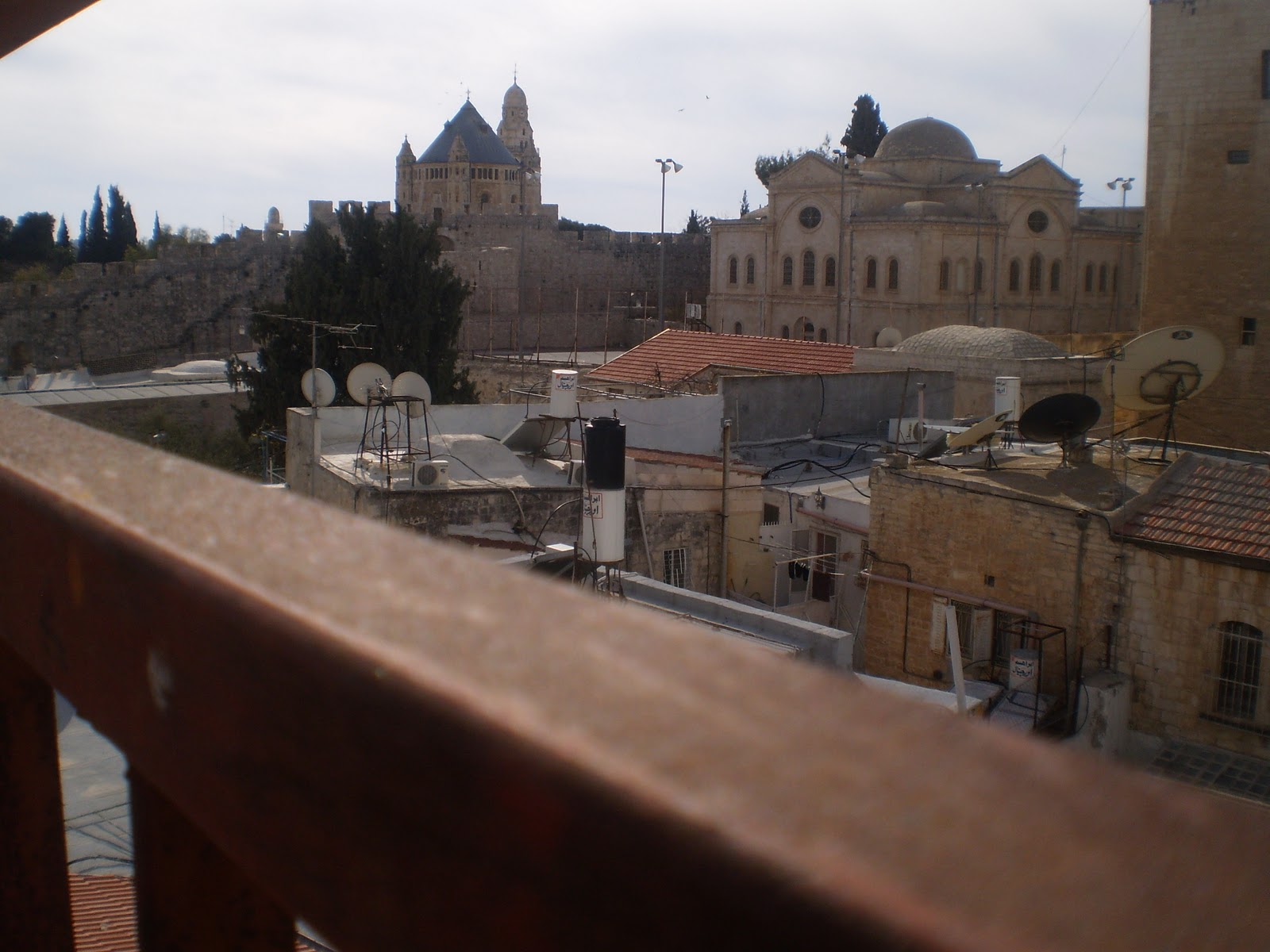
At one point Eyal took us up to a roof from which one can see stuff he wished to show us, and I took some pictures to show what I like to show: the sheer idiocy of dividing the Old City.

Here's the proposed division, as suggested by the folks of the Geneva Initiative:
The rooftop we were standing on is at the lower left (south east) corner of the section allocated to the Israelis, marked in pink:
The first problem with the north-south line next to the roof we were standing on is that it doesn't exist in reality. It's a straight line, you'll notice, but there is no straight line in that part of town that doesn't bisect homes, rooms, windowsills, doormats and kitchen cabinets. Don't believe me? Here, have a look at these two photos. They're both taken from the same roof, though in the second I moved a few steps to the left and the perspective changes a bit. In both of them, however, I'm looking north - so, along that straight line:
Note that both pictures show a high building right in front of a church spire, in the first picture it's to the right, in the second it's to the left. The church is part of the Armenian quarter, directly north of the roof I was standing on. The rooftop is part of the Jewish quarter, and I encourage you to find a straight line that might serve as a rational place to put an international border without bisecting anyone's bedroom.

It doesn't get any better when you look in the other directions. Here, for instance, is the perspective to the southeast:
The rail is an international border, then there's another one between us and the double-towered church. The rooftops below, however, are intended to be in Palestine. In the picture below, the international border will run between the rooftop I was on and the rooftop across the narrow alley, directly to the west.
Looking northwest the perspective is marginally less odd, but only because in the other directions it's so extremely wrong.
Most of what's in the foreground is the Jewish Quarter, with the new white dome of the reconstructed Hurva synagogue. Just beyond the edge of the hill is the Omar Mosque. Palestine, of course, according to the maps. The left half of the hill in the background is Mount Scopus, the Hebrew University, and thus Israel. The right half of the same hill is also Mount Scopus, but since there's a German hospital on the top of it (Augusta Victoria) it will be in Palestine. Finally, let's look due east:
The foreground is part of the Jewish Quarter, so Israel. The background is the Mount of Olives. Most of it is taken by the ancient Jewish cemetery, which has been growing up the hillside since early Biblical times. According to the Geneva Initiative folks, since the only people there are dead Jews, it belongs in Palestine. To the right of the top of the hill is an area which was purchased by Chabad before WW1, when it was an empty hillside next to the Jewish cemetery. Eventually Chabad sold it to Irwin Moskowitz who has been building Jewish apartment buildings there, commonly referred to by the Arab name of Ras el-Amud. Google it and you'll find lots of sources which will tell you these apartments are an obstacle to peace.

The American government, the EU, the UN, all of the international media, and Israel's Left are all convinced the idiocy I've reported on here is sane, reasonable, plausible, inevitable, and of course, it will be a fundamental cornerstone of peace. Apparently they all know something I don't know. After all, if everyone agrees on something, it surely must be true.

Sunday, January 16, 2011

World's 3 Largest Desalination Plants All in (Tiny) Israel

Well, actually, only two, right now. The construction of the third, which will be even larger than the two that are already in operation, began today; it will begin producing fresh water from the Mediterranean in 2013.

This is a nice story, but it has deeper layers to it. For years one of the standard stories about Israeli ineptitude, incompetence, inability to see beyond immediate political considerations and make long-term plans, and general stupidity, focused on the lack of water. The Sea of Galilee has been over utilized for decades, seawater has been seeping into coastal wells, sewage seeps into reservoirs - the works.I expect the stories were all true and justified. But then, a number of years ago, someone decided to get their act together, and within about a decade, the situation will have been turned on its head, all for the better. This fits a thesis I offer from time to time, that sooner or later Israelis notice major problems they're faced with, and purposefully set out to deal with them.

The minister who set the rectifying in motion in this case, was - if memory serves - one Avigdor Lieberman.

Reduced Israeli reliance on rainfall and its derivatives will someday make reaching an agreement with the Palestinians easier. So that's good, too. (And the doing of Lieberman?)

Bil'in on You-Tube

Balfour St. has been watching Palestinian videos from Bil'in. As you'd expect, the only way to see them as evidence for any Israeli wrongdoing, not to mention brutality, is if you've decided in advance that's what you're going to see, irrespective of reality. If you're impartial, neutral, or have any understanding of police work, riots, military occupations or other relevant matters, they show an IDF that's doing just fine.

My favorite snippet is near the end of the first video: a Palestinian demonstrator on a wheelchair has been overtaken by the Israeli troops, and he sits among them (embeded, might we say?) as they shoot tear-gas canisters at his folks. A few seconds later the troops have stopped at the line they wished to reach, and they're flanked by a handful of Palestinian men who for whatever reason haven't fallen back. So there's a line of IDF troops and Palestinian men, facing a second line of Palestinian demonstrators and photographers.

You couldn't make this up.

Israel-Palestine: the Emerging Reality on the Ground

A commenter on my post about how growing numbers of Palestinians in East Jerusalem would prefer to be Israelis wonders what would happen if the Palestinians of the West Bank (and Gaza) were to take the same line. What then? The question demonstrated to me once again how detached the reality in this area is from the discussion of it elsewhere. Set aside the malicious observers who seek somehow to roll back a century of Zionist success or millennia of Jewish aspirations, and revert to a Mideast without those pesky Jews. I'm not relating to them, but rather to the more-or-less well-meaning foreigners, Jews and non-Jews, who think there are theoretical principles that can be applied in an academic manner to the problems of this region, and they'll be resolved.

Here then is a description of the major development on the ground; there are other parallel developments that are pulling in other directions, but this most significant of them seems to be remarkably unremarked on.

Between1967 and 1987 the various territories of what had once been Mandatory Palestine were in a process of slow but noticeable convergence. It was all one political unit. There were no internal borders. Everyone roamed freely throughout. Hundreds of thousands of Palestinians from the territories worked in Israel, mostly in construction and other low-skill jobs. A growing number of Israelis were moving to the territories - though their percentage among Israeli Jews was always very small. The Palestinians with Israeli citizenship and the ones without were slowly growing closer; about 100,000 West Bank and Gaza Palestinians moved into Israel, often by marrying Israeli Palestinians (so the transfer of Jewish and Arab populations across the Green Line was roughly balanced).

In summer 1987 Sari Nusseibah went on Israeli television to announce that he and other Palestinians were playing with the idea of dropping their demand for Palestinian independence: "You Israelis are making partition impossible, so let's accept it and have a bi-national state", he said. Israelis of the Left (I was one, in those days) were horrified. This means the end of Jewish sovereignty, we warned; within a generation there will be an Arab majority, and by-and-by Zionism will be over.

In November 1987 the first Intifada broke out. This may have meant that Nusseibah was never reading his own community correctly, or it may have meant something else; I don't know. I do know that it changed the direction of the momentum. The Israelis stopped going to the West Bank (Gaza had been uninteresting all along), fewer and fewer Palestinian men came to work in Israel, Israel began importing Phillipinos and Thais in their place, and, perhaps most important, mainstream Israelis accepted that someday the Palestinians would have their own state and the settlements were a gamble that had lost. The convergence ended, and seperation emerged.

20-some years later, the separation is largely a done thing. Israel's radical Left still loves to tell about the Israeli occupation of Gaza, but they don't do facts. There is no meaningful way in which Gaza can be counted as part of the same political unit as Israel, and certainly not the same social or cultural unit. The West Bank is not far behind. Israelis, except for settlers and a dramatically dwindling number of IDF troops, never go to the West Bank (the current number of IDF forces there is smaller than at anytime since 1987). Palestinians effectively don't travel to Israel, except a small number of businessmen,and a large number (tens of thousands) who travel to Israeli hospitals. The ties between Israeli Palestinians and the rest are limited. The Israelis have a ramshackle and highly ornery political system, but at the end of the day it functions far better than most democratic governments these days, and under far greater pressures. The Freedom House report that came out last week places Israel solidly among the free. The Gazans have a ghastly theocratic police state, while the West Banker's have an inefficient kleptocracy under an unelected prime minister who seems to mean well. Freedom House puts them both near the bottom, deep in the Not Free category.

The Palestinian territories do not yet have political sovereignty, and there still are Israelis on the West Bank. So the partition is far from complete, clearly. But the major trends are clear. Societies create and maintain nation states when they've got some common denominator, a common something that enables them to act together, to live together, to accept political compromises. When they don't, sooner or later they either do, or they fall apart. India is a case for the former, Belgium is a case for the latter.

My point is that the geographical unit that was once Mandatory Palestine doesn't. The advocates of a One State Solution may chatter on to their heart's content; the reality on the ground is that with every passing month their option is getting further away. Jews and Palestinians never shared a language, history, a religion, culture, political tradition,a sense of common purpose - nothing. The Jews and the Palestinians who have Israeli citizenship (and to a lesser extent this includes the Palestinians of Est Jerusalem) are slowly and haltingly forging such a commonality. The Jews outside Israel still share a lot with the Israelis, though I fear the links may be weakening. The rest of the Palestinians, in the West Bank, Gaza, not to mention in the rest of the Arab World, are taking a different road. The moment when there could have been convergence has passed, and there's currently nothing to suggest it will ever be back.

Friday, January 14, 2011

Technology and the Internet Do Not Promote Freedom (Alas)

That, in a nutshell, seems to be the thesis of Evgeny Morozov's new book The Net Delusion: The Dark Side of Internet Freedom. The book is reviewed here, and what I'm getting from it is that human nature, once again, trumps technology. Dictators and other nasties can use technology just as well as freedom fighters, and increasingly, they do.Technology can change the world in many ways, but utopia is no more likely to happen than it ever wasn't.

Thursday, January 13, 2011

Do the Palestinians of Jerusalem Prefer to be Israelis?

In 1949, when Israel's War of Independence had just recently been won, there were about 100,000 Arabs among its citizens. At the time almost no-one called them Palestinians, not even they themselves. Until then they had been subjects of the British Mandate. Now they were citizens of Israel, and no-one really knew what that meant. Over the next 15 years, for example, many of them lived under military rule, unlike the Jewish citizens. At the same time, the State of Israel invested considerable funds and efforts to ensure all their children went to school, an effort no-one had previously made. (I wrote a bit about this here). It was a complicated story, with lots of shades of gray.

Then, in 1967, it suddenly took on a new and unexpected aspect. Following 19 years of near-total separation from the Arabs of the West Bank, who often lived a mere mile or two away, suddenly the separation was over. There was no border between Bartaa and Diab, Bakaa and Bakka el-Sharkiya, Jaat and Zeita, Taibe and Far'un, not to mention Beit Safafa and Beit Safafa. And yet, it wasn't really gone, the separation. To everyone's surprise, 19 years of being Israelis vs. 19 years of being Jordanians had caused a deep rift, and everyone saw it. (There were no Israeli-Arab villages right next to Gaza).

I'm not a scholar of the matter, but my impression is that as time went on and the Israeli occupation of the West Bank lengthened into years and decades, some of the distinctions became blurred. But many of them didn't. Then, when Israel began to build the separation barrier in 2002, the blurring receded. There was the famous case of the mayor of Um El-Fahm, the largest Arab town along the Green Line, who publicly sighed with relief when the fence went up alongside his town: finally the Israeli Jews will know we're not on the West Bank and they'll come back to our stores and restaurants on weekends, he announced; we'll be able to get on with the project of integration into Israel without the confusion of the West Bank folks (two miles south of his town).

One of the most controversial things Avigdor Lieberman keeps saying is the assertion that when the time for two states really does finally come along, Israel must insist that all those Arab towns I mentioned above must be defined as Palestine, not Israel, since their denizens are ethnically Palestinians,and should live in Palestine. Nothing makes them more furious.

That's the background for this story about the town of A-Taibeh, home of the Zuabi clan and their most famous daughter, Knesset Member Hanin Zuabi, who is probably the most vocal of the anti-Israeli voices among the Palestinian MKs. Apparently she's not at all appreciated in her home town, where everybody wants to accelerate the process of becoming Israelis, not aggravate the Jews. The story may fly in the face of what you expect, but it shouldn't. Wander around the Galilee these days and there are lots of signs on many levels that the local Arabs may identify ethnically as Palestinians (and they may not), but they are very serious about being Israelis. And their Jewish neighbors, rabid rabbis or no rabid rabbis, are mostly reciprocating the process. We haven't reached utopia yet, and probably won't for a while, but the trajectory is positive. I've previously written about this here, for example).

Then there's the case of Beit Safafa. This small Arab village south of Jerusalem was divided by the Green Line in 1949. The northern half of the village was in Israel, and became part of Jerusalem. The southern half was in Jordan. Then, in 1967, the southern half was also incorporated into Jerusalem and Israel, just like  Diab, Bakaa el-Sharkiya and Zeita weren't. A Palestinian friend of mine insists that as a result, the entire neighborhood is now the most Israeli of all East Jerusalem neighborhoods. 43 years of being in Israel have erased the chasm created by those first 19 years of not being in Israel.

The crucial question is if the same might happen in the rest of East Jerusalem. What happens to Palestinians who spend 35 years with the rights and benefits of being Israelis, and then, in 2003-4, they get physically severed from the West Bank? Because that's what's happening in East Jerusalem. The 270,000 Palestinians are cut off from the West Bank on the level of daily life (though they are allowed to travel there at will). They've got Israeli freedoms, Israeli health care, Israeli social security. Economically they're near the bottom of the Israeli standard of living (except the ones who are well off), but that's considerably better than on the West Bank and the possibility of improvement is significant. They can live anywhere inside Israel, should they so decide. This practical severing from the West bank is about six years old. How long will it take to achieve the same result as the 19-year severing back in 1948-67?

The Pechter poll presented yesterday suggests the process is already well underway. A plurality of East Jerusalem Palestinians want to remain Israelis. Haaretz summarizes the findings here. The full report is here, and a presentation based upon it is here. And note - since the report itself doesn't - that the numbers who prefer to remain in Israel are actually higher than stated, since the neighborhoods of Shuafat and Kfar Akeb don't really count, since they're outside the barrier and not really in Jerusalem. Kfar Akeb, for all practical purposes, is simply the southernmost neighborhood of Ramallah.

Speculation: what happens if sometime soon - say, ten years from now, which is a mere heartbeat in the story of Jerusalem - a clear majority of Jerusalem's Arabs actively want to remain Israelis, and, just like the Arabs of A-Taibeh, they refuse to contemplate the possibility of being citizens of Palestine? What then? Does anyone ask their opinion, or does the rest of the world insist that peace can be had only by dividing Jerusalem? I ask, because so far as I can see, we're well on the way to that situation, and getting nearer all the time.

Tuesday, January 11, 2011

Virtual Tour of the Shepherd Hotel Area

The other day a private developer destroyed a large Jerusalem building which has been empty for decades, so as to construct an apartment building on its site. The building, originally built by the infamous Haj Amin al-Husseini in the 1930s, was confiscated during WWII by the British, while Husseini was hobnobbing with his Nazi friends in Berlin, then by the Jordanians when they conquered the area in 1948, then by the Israelis when they conquered it in 1967. It was sold to Irwin Moskowitz in 1985, but only recently did he manage to complete the legal process that would enable him to develop it. Along the way it became known as the Shepherd Hotel.

The move was condemned world-wide, by Hillary Clinton, Catherine Ashton, Ban Ki-Moon, and many others, and of course by the Palestinian leadership. The condemnations all claimed the new apartments will be in East Jerusalem, and thus part of Palestine, and therefore no Jews may be allowed to live there and if they are this will prevent the division of the city and peace.

Set aside the legal aspects of the matter, not because they aren't interesting, but because they've been set aside by all the negotiating parties for at least the past decade. When on December 24th 2000 President Clinton slowly dictated his terms for peace to a group of Israeli and Palestinian negotiators, he determined that Jerusalem would be divided along the lines of ethnic division, irrespective of which part of the town had been in which country prior to its unification under Israel in 1967; his proposed lines would have had some Jordanian areas incorporated to Israel, and some Israeli ones incorporated to Palestine. Ever since then the principle of division along the ethnic lines has been the single option discussed in all relevant forums, effectively overriding earlier discussions of history, legality, morality or what have you.

I have written repeatedly about how this practical solution is not practical, and indeed should anyone ever try to impose it, the imposition will inevitably lead to violence bloodshed and eventually back to war (here, for example, and here). I have demonstrated this on various parts of town. (Here, here and here, for example),  Today I suggest we have a close look at the situation on the ground at the Shepherd Hotel compound.

First, the general area. Here's a Google Earth screenshot of the area to the north of the Old City in which the compound lies. (You can see part of the Old City at the bottom of the picture). Note that pre-1967 there was an island of Israeli territory to the east of the line of division; this is Mount Scopus, and before the division the Hebrew University and Hadassah Hospital had been there; after the division the Israelis had to shut them both down, even though they were still in Israeli territory, because the Jordanians wouldn't allow access to the mountain.

After unification in 1967, the Israelis built Jewish neighborhoods bridging the gap and connecting Mt. Scopus to Jewish Jerusalem. In the Geneva Initiative application of Clinton's principles, the change on the ground will look like this:
This is an interesting way of drawing the line, as it leave out some interesting information and possible complications.
The red triangle is where the Israeli national police headquarters and Ministry of Housing sit, raising the question why it was defined by the Geneva Initiative folks as Palestinian. The yellow blob is the British Counsulate, and has been an official British compound since the 1930s, so it's not obviously either Jewish nor Palestinian, either. The green blob I'll talk about in a moment: it's one of those sections of Jerusalem which defy ethnic cataloging. The Shepherd Hotel compound is the pink blob between the green and the yellow, which means that it isn't deep into a Palestinian neighborhood, but rather leaning on the fence of a Jewish one.

Here, lets see it all closer up.
 
 I've added three colored dots. At the bottom left there's a blue dot. That's the site of the memorial to the 78 Jews murdered by Palestinians on April 13th 1948. They were part of a convoy on its way up to the hospital and included the director of the hospital and many of his staff. The killing went on for more than six hours, though late in the afternoon when the British decided to put an end to the incident they did so in minutes. The consulate compound was manned by British troops at the time.
The black memorial is on the right; the consulate is the arched building in the upper center.

The yellow dot is the spot across from the entrance to the Shepherd complex where I stood earlier this afternoon and took four snapshots, one in each direction. West, into the compound:
 
North. The blue roofed compound is the sport center of the Hebrew University, and the 1967 line goes through its middle.
East. The HU campus is above, the buildings below are part of the Arab neighborhood of Wadi Jose, and the road between them is the highway to Maale Edumim.
 Finally, south. The Mount of Olives is above, Wadi Jose below it.

To the north of the Shepherd Hotel compound you'll see that I've added a light blue dot, at the intersection between the government compound and the Shepherd compound. Again, I stood on one spot, and pointed my camera left, then right. First, here's the Ministry of Housing, to my right.

To the left, here's the Shepherd compound, with all the trees. Less than a stone's throw from the ministry, and not figuratively. A real stone's throw.
 Finally, straight ahead, here's the compound I previously marked in bright green:
Near the top of the building you can see the logo of Briyut Klalit - twice. Once in Hebrew (right) and once in Arabic (left). Briyut Klalit is the name of the largest health insurance organization in Israel. The building, and the compound around it, is an Israeli institution, but since this particular branch serves the Arab population of Wadi Jose, most of its staff are Arab, and the language spoken in its hallways is mostly Arabic. So if you're dividing the city along ethnic lines, what is it? Do you go by the identity of the organization or the identity of the clients? If you decide it's Palestinian, the Israelis will of course shut down the building and its services, leaving the locals with no health service. If it's Israeli, then you're going to have to draw an international border between the health center and its clients, who will live in a different country and won't be eligible for its services. (And why should they be? Health services are paid by from the Israeli budget, from taxes collected from Israeli citizens. Not citizens of Palestine).

If the health center stays in Israel, the fence between it and the Shepherd Hotel compound will then be an international border. If there are Israelis living in the Shepherd area by the time the border gets drawn, the other fence of the compound will be the border. It's hard to see how either scenario is an existential threat to peace making, since the two fences are about 150 yards apart.

On the other hand, it's easy to see why the whole concept of drawing an international border along fences of properties might perhaps not be such a good idea. In the real world, I mean. From time to time I take foreign visitors for walks along the line the peace-makers propose, and am often asked why they don't see the division can't possibly work. I have no answer to this. Then my visitors ask me what the solution will be: if dividing the city will be a calamity, how do we reach peace? So far as I know, no-one has an honest answer to that.

The next chapter in this series is here, and tells about Har Homa.

Monday, January 10, 2011

Guardian Regrets Killing of "Palestinian" Man

Well, the actual headline in the Guardian said Israeli military "regrets" killing wrong Palestinian man in Hamas raid. But I think my editing of the quotation marks is better. Or at any rate, no less idiotic.

Melanie, Michael, and the Useless Israeli Hasbara

Melanie Phillips was on Israeli TV the other day, telling about the Guardian and its ilk in the UK, and the total uselessness of the Israeli response. The funniest part is the incredulity of the interviewer, Yaacov Achimeir, who has been around for decades, but hasn't the slightest idea what she's talking about.

She mentions Haaretz, by the way.

Michael Totten is another non-Israeli journalist who tells our story better than we do. He has the unusual advantage of having repeatedly been embedded in fighting American units in Iraq, which gives him a perspective on war that most journalists lack; when he finagles a visit to the IDF base where the infantry trains in urban combat he is much better informed than most journalists would be. Even so, however, its too bad that - so far as I can see - his is a lonely voice in the desert. It would be nice if he were part of, say, a small chorus. (The 10,000 strong chorus over here, the 5-strong chorus over there).

Sunday, January 9, 2011

The Utopia of Human Rights

Those of us who are old enough may perhaps have a fleeting moment of belated recognition upon reading that
Almost never used in English before the 1940s, “human rights” were mentioned in the New York Times five times as often in 1977 as in any prior year of the newspaper’s history. By the nineties, human rights had become central to the thinking not only of liberals but also of neoconservatives, who urged military intervention and regime change in the faith that these freedoms would blossom once tyranny was toppled. From being almost peripheral, the human-rights agenda found itself at the heart of politics and international relations.
In fact, it has become entrenched in extremis: nowadays, anyone who is skeptical about human rights is angrily challenged to explain how they can condemn Nazism—as if the only options that exist in political thought are rights-based liberal universalism or out-and-out moral relativism. The fact that those who led the fight against Nazism understood the conflict in quite different terms, with Winston Churchill seeing it simply but not inaccurately as a life-and-death struggle between civilization and barbarism, is not considered relevant.
You know what? He's right, the author. Human rights (the Germans call them Menschenrechte) weren't always the sum of all political thought, nor the only possible pinnacle of human endeavors. If they are now, it's a very new phenomenon.

Not that there's anything bad about human rights, of course. Yet as John Grey reminds us, until very recently they were something one required of the state - or, put otherwise, it was recognized they're impossible without a strong state to inform them, and thus if not subordinate, at any rate they didn't outrank the state. He does so while reviewing Samuel Moyn's The Last Utopia: Human Rights in History, which sounds like a book lots of people ought to be reading. (My list will keep me busy for 5.5 years without sleeping any nights, and that's just the top priority books). The thesis of the book is that in its present form, human rights has become a utopia: un-attainable, even theoretically, thus mildly harmful in the real world. Near the end of the review Grey takes the thesis further than Moyn does:
The intrinsically utopian nature of the human-rights project lies in what its advocates most prize about their movement—its antipolitical orientation. Basic human freedoms do not form a harmonious system whose dictates can be decided by a court, as Rawls and the human-rights movement imagine; they are often at odds with one another—freedom of information with the freedom that goes with privacy, for example. The role of politics is to devise a modus vivendi among these rival liberties. At the back of the rights movement is a vision of an ideal constitution that could in principle be installed everywhere. But such a framework is impossible even in theory, for there are ethical and political conflicts that admit no single, right solution. If neo-Nazism could be countered in the countries where it is reemerging by curbs on free expression and political association, would it be wrong to impose such limits? The answer depends not on any imaginary “rights” but on the effectiveness of the restrictions. Where they have a decent chance of working, I for one would happily support them.
Or the right to life on one side of a border vs. the right to life on the other side of it, I might add; but maybe that's just me.

(h/t, I think, Silke)

Friday, January 7, 2011

Economist on the Economy

One of my regrets about the Economist is that while they write a lot about Israel, they rarely write about its economy. If they did, this is what it might look like.

Europe Funds Hamas

Well, not directly, perhaps, and maybe not even intentionally, but in a new paper Ehud Yaari and Eyal Ofer argue that Hamas in Gaza has founds ways to live quite well off of the money various international entities pour in, or pour in to the PA which then pours in to Gaza.

Thursday, January 6, 2011

Critics of the Goldstone Report

Alan Dershowitz and I each respond, from different directions, to Letty Cottin Pogrebin's odd defense of Richard Goldstone, published recently in the Forward (and, not-surprisingly, in Haaretz).

Wednesday, January 5, 2011

More on the Mossad's Preturnatural Capabilities

Last month the Mossad used sharks to attack the Egyptian tourist industry. This week it was disclosed that they've trained vultures to smuggle alcohol into Suadi Arabia and destroy Arab virtue. Or something like that.
Residents and local reporters told Saudi Arabia's Al-Weeam newspaper that the Israeli bird seemed as though it could be a 'Zionist plot.'

Finding Gas Near Israel

Here's an interesting description of various aspects, political and economic, of the discovery of gas fields off the Israeli shore.

Israel's Homegrown Jewish Enemies

I have made no contribution to the furious discussions about the tragic death of Jawaher Abu Rahmah, first and foremost because I have no information beyond what everybody else sees. It also seems callous to be making political points out of the death, whether the points are being made by the top Palestinian leaders or furious Israeli bloggers.

The description in the NYT strengthens the feeling of distaste. The woman was standing with her mother and others outside their home, watching the weekly demonstration at Bil'in. At one point some tear gas fired by the Israelis wafted in their direction, harming no-one except Ms. Abu Rahmah, who collapsed, was taken to the hospital, and later died. Since no postmortem operation was done (or will ever be done) we'll never know what caused her death, but even if it was connected to the tear gas it was clearly a rare, freakish sort of accident. There's no plausible way it can be construed as an Israeli intention to kill, or even a foreseeable accident that should have been avoided by taking necessary precautions. You'd need a large dose of malice to charge otherwise.

The Palestinian leaders had that malice, and we've taken note, but we don't expect much better from them anyway. It's not as if they're our eager partners in negotiations towards peace. On the contrary. As Steven Rosen points out, they are non-partners to such an extent that the main question is why the Obama administration is letting them get away with it.

You can however see the problematic dynamic of the official Israeli response. The lesson learned from the Muhammad Al-Durra case in September 2000, and then from other examples since, is that Israel's enemies often blatantly lie about complex cases so as to create an irrevocable public perception of Israeli guilt, and by the time the Israelis complete their careful examination and can exonerate themselves, the story is long over and the damage is done. Hence the need to respond quickly - the problem being, however, that responding quickly can often be sloppy, and Israeli inaccuracies are as damaging as the enemy's lies.

I don't see how this can be rectified. Especially since there's a large market for stories of Israeli malice, irrespective of their veracity.

What has however been striking in this story is the alacrity, indeed, the overt and obvious need of certain far-left Israeli figures -journalists, NGOs, bloggers, they all know who they are - to convict Israel of a crime. I can understand, and even appreciate, Israeli observers who wish to hold our military to a high moral standard. Yet it would be reasonable to expect that when such observers detect wrong-doing, they'd try to get it fixed, out of a feeling of shame at what our side sometimes does. What's not defensible is the way some of them go out of their way, and bend over backwards, to make certain the IDF is guilty; indeed, they're at the forefront of casting doubt on any official attempt to clarify the facts. For these home-grown enemies of Israel, if there's any doubt whatsoever, there's no doubt: the Israeli troops are criminals, the investigating organs are liars, their defenders are thugs, and of course sooner or later the criminals will have to be brought to trial and if they're not it will be further proof of Israeli culpability.

It's sickening.

The sense of revulsion these people call forth eventually creates misguided responses, such as the decision in the Knesset this afternoon to investigate some of the NGOs. Not one of our finest hours, even if the NGOs earned the opprobrium with the sweat of their brows.

Tuesday, January 4, 2011

Israel's Wars, Memes, and Rational Thinking

A number of respondents to my post yesterday about Israel's wars raised points serious enough for me to follow up.

RK started by assuming the author at the Economist knows many Israelis won't agree with him, but he's writing for the readers who will. Perhaps. As I've documented from time to time in the past, however, the intelligent folks at the Economist are constitutionally incapable of seriously grappling with the possibility that the Islamist war against mankind, and its cousins, the Arab rejection of Israel and the Palestinian determination to remove Israel, are profound expressions of culture religion and history. As the Economist sees it, there are unfortunate responses in the Muslim world to conditions that make the Muslims unhappy, but if the conditions are addressed fairly the grievances will disappear. In practice, this means seeking a calm rational middle ground on which everyone can agree, except perhaps some diehard fanatics who will be marginalized by their own societies.

This has been the Economist's way of seeing the world for as long as I've been reading them, since the late 1960s. Rational engagement will be answered with rational engagement - sooner or later, at any rate - and the task of rational people is to seek that engagement at all times. It's a nice idea, sometimes it's even true, and other-times it can be disastrously wrong.

RK then went on, if I understood him corectly, to poke fun at what he called "memes". I can see his point, in that memes are sometimes unthinking slogans that replace rational thought. At other times, however, they can simply be shorthand for complex sets of ideas, and all of us use them when we don't have the time or need to work through the entire book. Thus, saying the majority of the Palestinians prefers No Israel over a small sovereign Palestinian state, and will prefer waiting for the first if having the second gets in the way, can be summed in the meme "The Palestinians aren't interested in peace". Obviously, one could write an entire book documenting this, or a daily blog linking to demonstrations of it, just as one ought to be on the lookout for signs that the situation is changing, should we ever get to that point. But if one's careful to remember that it's merely useful shorthand, there's nothing inherently wrong in using it.

Anyway, memes are often vastly more potent in forming history and motivating its actors than nuanced treatises. Here are some examples:
The Jews killed Christ
No taxation without representation
Equality Fraternity Liberty
Die Juden sind unser Unglueck
Freedom is not Free
Don't tread on me
Heim ins Reich
Rule Brittania
Not in my name
Yes we can
Illegal Israeli settlements

Y. Ben David asked why I don't take the correct position that the Palestinians are seeking signs of Israeli weakness to bolster their determination to wait for our disappearance, to its logical conclusion that any future Israeli withdrawals will merely strengthen them. A reasonable question, with two possible responses. One, the Palestinians aren't monolithic nor eternally frozen. What may be true today may not remain so tomorrow, for example, and it might even be possible to change reality by taking action. So if there's a Palestinian minority willing to live alongside Jewish Israel and it can be strengthened by carefully removing the irritant of Israeli occupation, this might be worth trying. My second, more clear-eyed response, is that the whole project of Zionism is that the Jews do what's good for the Jews, while taking cognizance of the implications of their actions, of course, but not limiting themselves to the dictates of others. So if ruling over large numbers of Palestinians is bad for Israel, we need to figure out if the damage may not be even greater than strengthening their opinions about our being weak. Put more directly: We need to stop ruling over as many Palestinians as we can; we must do so in a manner that strengthen us; once we've done so, we'll still have to deal with massive Palestinian rejectionism and some eagerness to be violent, but our own position will be stronger. It will be easier to withstand Palestinian enmity and violence - which will of course continue - from a position of broad internal consensus and some international acceptance.

Rukn attributed to me the idea that some people are inscrutable and some foreigners cannot be understood. I never meant to say this. On the contrary. I spent a number of years of my life in a concentrated effort to understand the Nazis, and I think I partially succeeded. If I had the time to learn Arabic and follow the relevant sources, I don't see why I wouldn't be able to understand the Islamists. (On a much easier level, I have no problem in understanding Dan Yakir and his friends on our radical Left). The human intellect always has the ability to understand the human intellect, and human emotion can mostly comprehend human emotion.

My point was that too often, we don't give our enemies the dignity of trying to understand them; rather, we tell ourselves how we would see things were we in their position, and then we assure ourselves that's how they indeed think. The result is that there's no meeting of minds, but there is rampant arrogant misinterpretation. Had Dan Yakir tried to place himself in the shoes of that judge, he'd not have castigated him the way he did; instead, he applied his own interpretation to the words of the judge, and ended up with a travesty. Were the diplomats of the world to listen seriously to the Palestinians, they'd recognize that the Israel-Palestine conflict cannot be resolved right now by creating a tiny Palestinian state on the West Bank, and the eventual horror of dividing Jerusalem would not be discussed. Were the leaders of the world's powers to listen to the fabled "angry Arab street" so as to understand how it explains reality and what motivates it, rather than smugly assuring themselves they know how to soothe the poor barbarians, they might be developing dramatically different policies than the ones they're pursuing.

Useful Links

Jeffrey Goldberg last week got it all wrong when he blogged about Israel's potential loss of democracy. I was offline, however, and didn't find the time to respond. In the meantime, Victor has done a good job at it.

The Military Attorney General (MAG) of the IDF has posted some information about naval blockades in international law and the application of the laws to Israel's blockade of Gaza. Knowing how lawyers operate there will be inevitably be some who disagree, just like there are those who disagree that Israel has left Gaza, or has claims to Jerusalem, or any of the usual things. Still, it's good to see this material online.

If you thought George Kennan finally died, in 2005, well, apparently not. Werner Scholem, however is long dead - but worthy of a quick moment of memory.

What Are Israel's Wars About?

Yesterday I mentioned the outlandish worldview held by some of Israel's radical left, and I focused on Dan Yakir, the legal counsel at ACRI. Seen from my vantage point, he and his colleagues are immune to rational thinking, and he's convinced the same is true of me (and most of Israeli society, since I'm a mainstream centrist). All of which is mildly odd, when you keep in mind that Dan and I are of a similar age, we live in the same small society even if in different segments of it, in the same very small country, and in the same language; we've even known each other, in a lazy sort of way, for perhaps 15 years. Yet not only do we disagree, we can't even find the common ground on which to base a discussion of our disagreements.

The world is often like that. The really surprising thing isn't that people have incompatible understandings of the world, but that people attribute their own understanding to everyone else; that observers interpret the actions of others through the prism of how the observers think, not the observed; that professional observers insist on the hubris of applying their own standards to the actions of the people they're observing.

Take The Economist - one of the most professional and intelligent set of observers and reporters anywhere, the top of their profession. Their leading article this week is about how the Obama administration must - must - force a solution to the Israel-Palestine conflict on the warring sides. Set aside the abysmal silliness in the assumption that America, or anyone, can force warring societies to stop being warring societies, if they wish to continue warring, or even if only one side so wishes. Old King Canute couldn't even stop the rising tide, and that was only about dry and predictable laws of physics, with nary any human agents or irrationalities at all.

But as I said, let's not be distracted by technicalities. Instead, let's focus on the heart of the matter:
To start with, at least, peace will be incomplete: Iran, Hizbullah and sometimes Hamas say that they will never accept a Jewish state in the Middle East. But it is the unending Israeli occupation that gives these rejectionists their oxygen. Give the Palestinians a state on the West Bank and it will become very much harder for the rejectionists to justify going to war.
The Weltanschauung behind that paragraph is that most people in the region, foremost the majority of the Palestinians, would prefer peace and dignity in a small but sovereign Palestine, over war and conflict with no sovereignty. That a small reality is better than a large dream.

(As an aside allow me to wonder how often the forbears of the English (the Economist is London-based) preferred small realities to big dreams. Then let me wonder if preferring small realities to big dreams might not have prevented the coming into existence of, say, the United States of America, partly through the work of English dreamers. Assuming small realities always trump big dreams is pure bunk. But I digress.)

What if, however, most Palestinians, Arabs, and even Muslims, truly and fervently believe that the dream of No Israel is an inevitable certainty, ordained by God or History or Destiny or Justice or All of the Above? What if they feel that a small sovereign Palestinian state alongside a Jewish one is not only not a goal worthy of pursuing, it's an abomination? Or if not an abomination, at most it's a cynical stepping-stone on the road to the inevitable No Israel?

I'm not saying that's the reality. I'm merely broaching the theoretical possibility, so as to ponder what the practical implications might then be.That's what pundits are supposed to do, isn't it? To imagine different possibilities and outcomes?

Then again, perhaps it is the reality. You may have seen this article by Saeb Erekat, a few weeks back. Erekat is the top Palestinian negotiator under Mahmoud Abbas. He has been around for many years. No description of the Israeli-Palestinian negotiations will ever fail to mention how moderate he is, how close and warm his relations with his Israeli counterparts in the peace-making camp. Erekat is often held up as living proof for the viability, indeed, the near inevitability, of peace, if only the Israelis would desist from their various stubbornness.
This period of dispossession, known to Palestinians as al-Nakba or "the catastrophe", is the seminal Palestinian experience and source of our collective identity. In fact, the current Palestinian president, Mahmoud Abbas, is himself a refugee displaced from the city of Safed during the 1948 war when he was only 13-years-old.
Today, Palestinian refugees constitute more than 7 million people worldwide – 70% of the entire Palestinian population. Disregarding their legitimate legal rights enshrined in international law, their understandable grievances accrued over prolonged displacement, and their aspirations to return to their homeland, would certainly make any peace deal signed with Israel completely untenable.
Does that sound like a man who is yearning for a small reality over a distant dream? True, at the end of the article he tacks on some weasel words about how giving the Palestinians the right to overturn Israel's victory in a defensive war in 1948 "will not change the reality in the Middle East overnight, nor will it lead to an existential crisis for Israel."- but that's actually for Israel to determine, not for him, so the words are meaningless.

Just last week I read Jonathan Spyer's excellent new book Transforming Fire: The Rise of the Israel-Islamist Conflict, which I hope to review sometime soon. In the meantime, however, here's a taster, from page 63 where Jonathan sums up the section on Hamas:
Hamas among the Palestinians is now articulating the deep sense of strategic optimism that has always characterized the Palestinian and broader Arab and Muslim views viz a viz Israel. According to this view, the existence of Israel is in opposition to the natural state of affairs in the region, and to the usual laws of human development. Since this is the case, what is required is to keep the struggle going, never to give in, until the final victory.
[He then describes an interview he made with Nizar, a Hamas leader in Ramallah, in 2008]
The Israelis, he said, nowadays just wanted to be left alone. Gone were the days when they sought to expand and conquer. The Zionist project, he said, had begun with the desire to to create a Jewish state between the Nile and the Euphrates rivers. Then, because of Arab resistance, this ambition had shrunk to a desire to expand Jewish control to the entire area between the Jordan river and the Mediterranean Sea. Determined Arab and Muslim resistance had now shrunk Zionist ambitions even further.Now, all the Israelis wanted was to be able to keep what they had. But this, too, was only a stage...
The fact that the Jews, in his view, now wanted only to be left with the current situation, was proof that the way of resistence was correct, and was in the process of delivering victory...
Here was a genuinely held ideological position. Nizar, unable to leave Ramallah because of fear of arrest at the hands of the IDF, harried by the security forces of Mahmoud Abbas, was calmly confident of the utter inevitability of the Muslim victory in the long, slow war of attrition of which he was a part.
The last time the Palestinians had free elections Hamas won hands down. The Economist, like all good media, knew this was because Fatah was corrupt, not because anything about the message of Hamas appealed to Palestinian voters. How they acquired this certainty was never explained. The implication was that Western pundits couldn't imagine a centuries-long conflict to rectify nature, so the Palestinians obviously couldn't, either. This in spite of the irrefutable fact that Dan Yakir and I can't even agree on the motivation of a judge in one of our minor courts.

Monday, January 3, 2011

Blaming the Jews for Murder

The Iranians, Hisballah, and some Egyptians are all blaming the Jews for the mass murder of Copts in Alexandria. They seem all to believe it, too. Antisemites generally believe their lies; never underestimate them.

Sunday, January 2, 2011

The Guardian Admits it's Obsessed with Israel

A Guardian blogger has been crunching some numbers, counting how often the paper mentioned which countries in 2010. The UK comes first, of course: it's a British paper. The US comes second, which is a no-brainer. Next come Afghanistan and Iraq, two countries in which there have been or still are fighting British troops, so the interest in them is arguably local. China, the world's largest country and its economic motor in 2010, is the first really foreign country on the list, at 5th place.

Then comes.... Israel.

Ahead of all the rest of the world. Ahead of next door Ireland, the country with the frightening banking crises. Ahead of South Africa with the World Cup. Way ahead of Haiti, where nothing ever happens, not to mention Sri Lanka with its wars, rigged elections and large refugee camps. Congo (remember? The country with millions of casualties in the world's bloodiest war since 1945?) - Congo gets mentioned about one ninth as often as Israel.

Belarus, the last Soviet dictatorship in Europe, with a stolen election and no human rights to speak of, is hardly on the list at all.

ACRI is Impervious to Rational Discussion

Here's a typical story about the mindset of Israel's radical Left these days.

Last week a court in Ramleh sentenced Nuri el-Aukbi to seven months in jail for operating a business in Lod without legal permits. So far as I can see from the conviction, this is at least the third time since 2003 that el-Aukbi has been convicted for the same thing; each time the court orders him to shut down his business he not only refuses to comply, he builds additional structures onto the ones he's been ordered to shut down. A fine and upstanding citizen.

Ah, but there's a snag. In addition to being a serial offender against zoning and business-license laws, el-Aukbi is an activist in support of Bedouin rights in the Negev, some of which touch upon... laws of zoning and licenses. At his most recent trial, el-Aukbi or his lawyers seemed to think this should be a mitigating condition, and suggested the court be lenient since in other, unrelated matters, he's engaged in important things.

The court didn't oblige. On the contrary, when handing down his sentence, Judge Yemini noted that a social activist who speaks in the name of human rights and rule of law, ought to be careful he himself is above reproach in these matters. El-Aukbi, sadly, isn't. Rather the opposite. And note that the court was responding to a line of argumentation that had been presented to him, not initiating the discussion.

Dan Yakir, the legal advisor of the Association of Civil Rights in Israel (ACRI), harshly castigated the court. "The judge essentially said he was punishing el-Aukbi for his activities of support of the Bedouins in the Negev, so as to warn them off... This scandalous case is yet another example of how the courts are being used to discourage political actions." Inevitably, Yakir then added that in a healthy democracy political activity is to be applauded, not punished by the courts.

Fortunately this time the story is so far on-line only in Hebrew (and follow the links to the court documents).

The weirdest thing is that Yakir and his colleagues truly believe their own narrative, and are quite impervious to any other possible explanation. If someone is a political activist on their side of the political divide, he must be immune from prosecution for anything, and if he isn't, this is proof Israel, like Putin's Russia, is rapidly becoming non-democratic.

Saturday, January 1, 2011

Budgeting West Bank Settlements

One of the meta-narratives of Israel's political Left these past three or four decades has been that the settlement project costs billions, and if it didn't exist there would be lots and lots of money for worthier things. Haaretz handed the job of presenting the case this year to Akiva Eldar, a veteran reporter with great command of his material. Of course, he's also first and foremost an ideological journalist, which means that while he'll never lie, he'll routinely cast his data in the mode he thinks will best serve his agenda. This also means that if a reader has his own command of the data, Eldar's articles can sometimes lead to surprising and unintended insights.

Here's his presentation, claiming the national budget which just passed allocates more than 2 billion NIS to the settlements. Feel free to read it in its entirety before continuing with my comments.

Eldar's first omission is the overall size of the budget. It's about 350 billion NIS (the $ is currently about 3.5 NIS). Which means less than 1% of the budget goes to West Bank settlements.

How many Israelis live on the WB? That depends how you count them. If you mean all Israelis who live beyond the Green Line including in Jerusalem, it may be about 500,000, though to them you'd need to add the 270,000 Palestinians in East Jerusalem who also benefit from the budget. Say, 800,000 people from a population of 7.7 million. And they're allocated less than 1% of the budget? Is this possible?

Clearly that's not what Eldar means. What does he mean? It's hard to tell, since well over a billion of the NIS he's informing us of are earmarked one way or the other for projects in Jerusalem or nearby Maaleh Adumim, yet he never mentions the cost of routine or long term services for the roughly 1,000,000 people in the area. He chooses a few projects he doesn't like, and overlooks the rest.

So far as I can see from his very opaque numbers, the sums allocated to construction of any sort in the settlements beyond the barrier, i.e. those even the Bush administration always intended to be Palestinian, can't be more than a few hundred million NIS, for a population of, I'd guess, less than 100,000.That's serious money, and I agree with Eldar it's money spent unwisely, but it's hardly more than 0.1% of the national budget. Hardly earth shattering.

Note also how he totes op the 900 million (out of 2.5 billion which are the subject of his report) allocated to three colleges on the West Bank. Say Israel were to evacuate the WB tomorrow morning: would that expense disappear? Don't the people going to college need to be budgeted no matter which hill the college is on? Not to mention that in the largest of the three, at Ariel, a sizable minority of the students are Israeli Arabs, whose education costs Eldar has just deftly counted as part of the Israeli efforts to build on the West Bank.

It would be easy to pick apart additional numbers from his report, but there's no need. Even according to his own narrative, Israel is clearly putting only minor sums into the settlement project, and even parts of that are covering expenses generated by people, not settlements, i.e they'd need covering in any case. Hardly what Haaretz and their veteran reporter hoped we'd understand from their article.

Due disclosure: I think any investment beyond the line of the barrier is a waste, since my consistent position for decades has been that Israel shouldn't be building there, even if I understand why it has. But I don't appreciate demagogic manipulations.