Wednesday, May 5, 2010

Defining and Practicing Slander

There's been a spot of unease here in recent days from readers who dislike my use of the word "slander" to describe some of the actions of our radical left. The question has been raised if perhaps I'm simply smearing people whose opinions I dislike.

I think not, and here's why, with an example.

Slander, in my book, is the willful dissemination of a lie, or the conscious airbrushing of a story, often by deleting essential contextual elements, so as to achieve a derogatory effect where an honest depiction would not have this effect. Put more simply, slander is lying in a way that makes someone look unjustifiably bad.

Saying you've heard allegations by Palestinians that IDF troops shot civilians need not be slanderous, first because it could conceivably be true, though hopefully not, and second because you're admitting that your sources are partisan. This will become slander if you never allow the IDF to rebut the allegations. Saying that IDF troops shot Palestinian civilians, as an unquestionable fact, and adding that they did so because there was an Israeli intent to kill Palestinian civilians, is slander, unless you can show relevant Israeli proof for such an intention. That's why the Goldstone report was slanderous; it's also one example among many which I've written about in which Israeli NGOs of the radical left played with slander.

For an interesting test case, let's read the Haaretz editorial of this morning, here. (Feel free to read the whole thing before continuing with this post).

The editorial starts with a bombshell, which ought to have been at the top of the front page, but wasn't:
The Ministerial Committee for Legislation did the right thing on Sunday when it rejected the “loyalty law” bill proposed by Yisrael Beiteinu. The bill would rescind the voting rights of anyone convicted of terror activity, the murder of innocent people or attempting to harm the democratic foundations of the state. The committee was wise enough to understand that this was an antidemocratic bill that could have opened the door to stripping citizens of the right to vote.
Remember the endless talk about how Avigdor Lieberman's party was going to destroy Israeli democracy with this law? Fascists, that what they were called, in reports the world over. Some of us said at the time that the law would never be enacted, not because we're so smart but because we understand how Israeli politics work, but no-one listened. A year later, the proposed law is dead, killed not by the opposition or the media, but by.... the government! That's right: Netanyahu's far-right warmongering antidemocratic government, they're the ones who killed the law, even as Lieberman and his colleagues sit in it; moreover, they didn't even kvetch! They did their grandstanding last year, it served its purpose, and there was no longer any need for the law, on the contrary, there was every reason to make it go away.

Did the editors of Haaretz, and all the spokespeople of the radical left know in advance this would happen, back when they were spewing their hatred in all directions? Of course they did. We all knew. It was obvious. Did this stop them from speechifying? Of course not. Was it slander, back then? Well, yes and no. In Hebrew it wasn't, in English it was. I'll explain.

Israelis have, how to put it, a lively way of discussing matters with one another. In the eyes of most foreign observers it seems ferocious, vituperative, rude in the extreme, outlandish, and shocking. Yet simultaneously, they've got a control of themselves that many other societies lack. There's a sense of proportion, and the ability to maintain meaningful human relations irrespective of the constant mudslinging. They scream at each other, and then sit down to a plate of hummus, or perhaps to plan their trip to Turkey ("those antisemitic bastards").

Some of you have noticed Didi and myself banging away at each other in the comments section. We've actually never met, but for the past week or so we've also been having a perfectly civil discussion on a totally separate matter, as if this blog doesn't exist, while sniping at each other here as if that discussion wasn't happening. This is perfectly normal.

One axiom of Israeli political discourse is that everyone always discounts 50% of what anyone says. "This means the end of Zionism!!!", someone thunders. Everyone else pays no attention, waiting for him to get past the bombast and to the point. "Slime! Despicable! Evil!" U-huh. And your point is...? We hate you, too, you know. Except when we don't.

My point is that for better and for worse, but mostly for better, it's uncommonly hard for Israelis truly to slander one another, or even really to offend each other on a fundamental level. The fanatics at the edges can do so, but most of us, most of the time, fondly nurture our myriad animosities, but don't let them interfere with sharing society.

(An interesting expression of this is the perverse popularity of MK Achmad Tibi, who always tells us outlandishly offensive things, yet we're sort of fond of him. The other day he and some right-winger were on some radio talk-show together, discussing a European football match about which they- obviously - disagreed. Tibi's Hebrew is so very perfect, even if he's got a thick Arab accent, that you've got to admit he's inside the club).

This is all so deeply ingrained that if we ever take the time to watch American politicians in argument, or Brits, or Germans, we find it puzzling in the extreme; how do they really know what he's saying, when he doesn't say it forcefully, bluntly, and in their face? When do you know she's being courteously understated, and when unsure of herself? How can you take someone seriously if they're not passionate about what they're saying, if they're not growling from the stomach?

Take the exact same Hebrew discussion, however, and move it into English, and it's something quite different. Present it in English to a public which shares none of the underlying intimacy, none of the common values, none of the ability to decode the symbols and perceive what's really being said, and it's a very different ballgame. Let's read the next part of that Haaretz editorial. I'm citing it in English, but it was written in Hebrew. See if you can figure out what's really being said:
But as the bill of the right-wing, nationalistic Yisrael Beiteinu party was apparently being removed from the agenda, an even more antidemocratic and dangerous bill was introduced in the Knesset. This bill would outlaw any Israeli nonprofit associations or other organizations that give information to foreign authorities and work toward prosecuting Israeli politicians or military officers for war crimes. And who are among the sponsors of this bill, which smells strongly of McCarthyism? MKs Ronit Tirosh and Otniel Schneller of Kadima, who joined forces with two MKs from the extreme right. In doing so, Tirosh and Schneller have painted their party with right-wing, nationalist hues. Above all, their draft law is proof that Kadima has lost its way and is suffering from ideological anarchy.
Hebrew: We really don't like that proposed law. You know how badly, because we're using over-the-top terminology, to make sure you get our point. On the other hand, hidden away behind the frightening "would outlaw" we've stuck the tidbit that we're not bothered by hauling IDF officers before foreign courts. We're not like Kadima, the centrists: we've got the truth. In order to emphasize that, we're going to tell you Kadima has become - horror of horrors - an extreme right-wing party! ("this means the end of Zionism!")
A state that outlaws groups that dare to criticize it cannot be considered a democracy. A party whose elected representatives introduce such proposals is not centrist, and the head of a centrist party who allows them to do so is not a leader.
Hebrew: Well, we all know perfectly well that this law has even less chance than the Loyalty Law. That one was backed by a party, this one is mere grandstanding. We also know that even though it's dead in the water, it doesn't call for suppression of free speech at all, it calls for minor sanctions against organizations which lie to foreign authorities or try to have IDF officers tried abroad, neither of which have anything to do with democracy. Haaretz knows this as well as the rest of us. What they're doing, however, is the totally acceptable act of shouting their opposition to the high heavens - which is perfectly alright, it's even their duty.

Migrate this internal argument into English, however, and it's only a matter of hours before some enemy of ours uses it. Juan Cole, say, or the main German TV news, and of course the BBC: Kadima is a far-right party, beyond the pale in any democratic society.

That's the slander. Haaretz engages in it often. The radical left engages in it compulsively. It's not antidemocratic of us to deride them for it.

The Myth of the 1967 Borders

Dore Gold shows that the Green Line was not thought of as an international border until many years after it no longer existed. To my mind this doesn't mean that it cannot serve as a point of agreement between Palestinian and Israeli negotiators, but it doesn't have to. The entire "international law" narrative on the matter was invented only later, and is an anachronism.

In fact, Article II of the Armistice with the Jordanians explicitly specified that the agreement did not compromise any future territorial claims of the parties, since it had been "dictated by exclusively by military considerations." In other words, the old Armistice Line was not a recognized international border. It had no finality. As a result, the Jordanians reserved the right after 1949 to demand territories inside Israel, for the Arab side. It was noteworthy that on May 31, 1967, the Jordanian ambassador to the UN made this very point to the UN Security Council just days before the Six-Day War, by stressing that the old armistice agreement "did not fix boundaries".

After the Six-Day War, the architects of UN Security Council Resolution 242 insisted that the old armistice line had to be replaced with a new border. Thus Lord Caradon, the British ambassador to the UN admitted at the time: "I know the 1967 border very well. It is not a satisfactory border, it is where the troops had to stop." He concluded: "it is not a permanent border." His U.S. counterpart, Ambassador Arthur Goldberg, added that "historically, there have never been secure or recognized boundaries in the area"; he then added that the armistice lines did not answer that description.

Hanging Judge

The front page of Yediot Achronot, our most popular newspaper, has a story about one Judge Richard Goldstone. Apparently the man was a judge in South Africa's Apartheid regime, and in that capacity he sent dozens of blacks to the gallows, and others to be lashed.

Interesting, isn't it.

Update: There's no link to the Yediot Achronot story, but Silke found a description of at at the Jerusalem Post, here.

2nd update: Asaf found a link to the story in Hebrew, here.

BDS Seeks New Frontiers

What with all their failures of recent weeks (and years), the Boycott&Divestment gang is seeking new campuses to poison. Some of the locals at Stanford, however, are trying to launch a preemptive counter campaign, the sneaks.

Tuesday, May 4, 2010

The NIF Slogs On

Someone broke into the Jerusalem offices of the NIF. The CEO of NIF Israel, Rachel Liel, says she and Naomi Hazan are receiving threatening letters.

Assuming the burglary has anything to do with anything, these are disturbing developments, and must be unequivocally condemned, with no "ifs or buts".

Proportions, however, that's another matter. An unknown number of unidentified hoodlums, probably cowardly acting anonymously, remain unidentified and hoodlums until proven otherwise.

Daniel Sokatch, on the other hand, the CEO of NIF, is a public figure with some authority; people respect him, take him seriously, admire him for his commitment to Israel and its causes. (In America. In Israel no-one has ever heard of him). When he sends out a mass e-mail calling on America's Jews - or at least those of them identified by the NIF - to write large checks ASAP, because only the NIF can save Israel's soul, this is partly pure cynicism, and partly a demonizing of Israeli society, and largely breathtakingly arrogant, and above all a distorted falsehood.

We have our work cut out for us. Ha’aretz reported today that more than half of Jewish Israelis believe that the free speech rights of organizations like the New Israel Fund should be limited. The survey finds that a majority of respondents think there is too much freedom of expression in Israel.

Please make an urgent contribution to the New Israel Fund today. Your support will help us take a stand against extremism and protect democratic values in Israel.

This new demonstration of the decreasing commitment to bedrock democratic principles presents one of the most fundamental challenges in the long history of the New Israel Fund. We are committed to reversing this trend and we need your support to make that happen.

As profoundly disturbing as this news is, it should come as no surprise to us, in light of increasing efforts to stifle dissent within Israel. The attacks on NIF in particular have been exceptionally virulent. We continue to confront scurrilous public campaigns fueled by outright false allegations and willful misrepresentations of who we are. Our adversaries have gone so far as to call for people to pray for harm to us and our allies who dare to question government policy -- a truly despicable act.

The New Israel Fund is not standing idly by as freedom of speech and conscience are sacrificed to a dangerous political agenda. Our work in Israel is the single most important investment that you can make in democratic values and freedom and justice for every Israeli.

From a human rights march that drew thousands of ordinary Israelis to victories in the High Court ….from strengthening liberal voices in the Orthodox community to empowering Israel’s minorities to fight for their rights ….the work of the New Israel Fund family is the antidote to the creeping erosion of democratic values.

The ferocity of the attacks on NIF and the organizations we support demonstrate the fear and anger that underlie nationalist and religious extremism. Our adversaries know that we will not retreat from our vision of a Jewish and democratic Israel that actually lives up to its standing as the only democracy in the Middle East.

Thank you for your support, and please make a special contribution to allow us to build new programs to defend democracy in Israel. Together, we’ll build a Jewish and democratic Israel we can all be proud of – an Israel that rightfully keeps its place in the ranks of free and democratic societies.

Then there's this revealing little news item (only in Hebrew, obviously): The NIF's Palestinian program is calling for proposals to build programs that will reduce the level of violence in Palestinian society. Somewhere, deep down in the psyche of the NIF, someone seems to have at least some grasp on reality.

But don't expect Sokatch to be sending out e-mails about this anytime soon.

Monday, May 3, 2010

Towers on a Hill

We've got a major corruption story on our hands these past few weeks. If you believe the spin, a former prime minster, two former mayors of Jerusalem, lots of important civil servants and a gaggle of lawyers and investors will all eventually go to jail.

Earlier this afternoon I had a chat with one of our very top journalists. I won't name him, but he would be at or near the top of the list of any informed Israeli asked to name our important journalists (so: it's not Gideon Levy). I was asking him about the story, which has been rumbling along for a month or so, and he commented - correctly, but a bit surprisingly - that 100% of what we're getting these days is slanted information crafted by folks who may or may not know what they're talking about, but are primarily committed to getting their version out to the public, irrespective of its accuracy.

So that's comforting to know. Sounds like most of the news-cycle the world over.

The other day The Economist reported on the story. I read the Guardian to follow the themes of current antisemitism. The Economist, however, I read - a bit warily - in the hope of hearing what goes on in the world. So what, I ask myself, am I to make of this?
THE distinctiveness of Israel’s latest corruption scandal is that it almost literally hits you in the eye. Many Jerusalemites feel affronted each time they look up at the Holyland Project, a string of four high-rise buildings tearing through the skyline on the western hilltops edging the city. Five more towers are to rise up under plans inexplicably approved by the municipal and district authorities.
Here, have a look (source):
Does that look like four towers? I think it looks like eight, but maybe that's just me. For the life of me I can't see how it can be construed as four. Another four are planned, making a total of twelve (12).

How to explain the report of the Economist? I admit, it's not that crucial - but nor is it hard to get the true number. There are complex stories in the world, one or two even here in Jerusalem. But this is not one of them.

Lots of Strands

Yesterday I introduced Zohar Argov, the hero of Shirim Mizrachi'im, the Sephardi wing of Shirim Ivri'im which has long since become one of the lanes of the main highway.

The Shirim Mizrachi'im tend to gravitate towards two types of content. Personal songs of love, anguish after love and regret about love, in a manner that might be called the Israeli version of American Country music (though that's where the similarity ends); and religious songs. Remember, the Sephardi Jews tend to be less fanatic at religion than some Ashkenazis, but also much less secular - or if, then a secularism deeply informed and living alongside religion. The songs I brought yesterday belonged to the first group; here's an example of the second.

Shabechi Yerushalayim (Jerusalem, Praise the Lord) is verses 12-13 of the 147th Psalm, so it's been around for a long time. Here's a possible translation of the Psalm, though Google will offer you many others. The two verses in Hebrew, as they've been adapted to the song are here, and the English song-structured version is

Jerusalem praise God
Tzion praise God
Jerusalem praise God
Tzion praise God

For He made your gates locks strong

For blessed the sons that sit in your city

Praise God Tzion
Praise God Tzion

Tzion is of course Zion in English.

The fellow who rendered the ancient Pslam into a modern song is Avihu Medina, born 1948 in Tel Aviv, one of the most important creators and occasional singer of Shirim Mizrachi'im. Badad, for example, which we saw yesterday, was written by him for his friend and protege Zohar Argov. I've linked to three You Tube versions. The first is by Avihu Medina himself, a few years ago. It's quality isn't very good, but it demonstrates how such shirim are often performed: at some local event, in cramped quarters, with everyone singing along. This particular recording is poignant because 11-year-old Roy Ginat, a blind child, got on the stage and played the accompanying keyboard. So it gives that aspect.

The second is by Hadag Nachash, a modern loud-noise band whom I've already introduced. In this case, they were giving a loud-noise concert at a Washington DC synagogue, when they launched into Shabechi Yerushalayim. I expect the original psalmist was spinning in his grave, but then, after 3,000 years of decay maybe there isn't enough coherent skeleton left to spin, so who knows. This video is interesting because by now (2006?) the Jewish-American Ashkenazi teenagers and students in Washington DC all know this Mizrachi song, and sing along, unsuprised that it's being offered by a band that normally does stuff that is not recognizably music if you were born earlier than, say, 1985.

I keep on carping on the point that Jerusalem is an important place for the Jews; this gives a surprising perspective on how that works.

The third recording is even more surprising. It's by Glykeria.

Glykeria is one of a few Greek singers, non-Jews from Greece who don't speak Hebrew, who have reciprocated to the Israeli public's love for Greek music and its incorporation into Shirim Ivri'im, by joining, and recording their own versions of the Israeli songs. Glykeria, born in 1953, first reached prominence in Greece in the 1980s, about the time Shirim Mizrachi'im were breaking into the Israeli mainstream. I don't know enough about such matters to say what her homeland stature is these days, but she was recording there for at least 20 years, and still visits Israel to sing the common music. (A stance which has gained her some enemies at home, of course). So here you've got a Greek woman, singing what is obviously Greek music, except that the words were written centuries before the heyday of ancient Athens, and unfortunately stand at the very center of international disagreements of the highest degree till this very day. The world never ceases to amaze, does it.


Sunday, May 2, 2010

Three Stories about Staying Power

From time to time I pose the question - as a question, not an answer - of the ability of non-Israeli Jewry to sustain itself over time. I usually ask if it has staying power, since without it, Jews don't remain Jews for more than a few generations. Here are three recent stories about Jewish staying power.

The Bible doesn't much deal with non-military threats to Jewish existence, except a bit in some of the latter sections. Thus, the commandments to hold on no matter what, and the conceptual-religious-cultural mechanisms of doing so were mostly developed in the second millennium of Jewish existence. No single source for this is more important than the discussion initiated at Lod (Lyyda), where a wealthy Jew named Nitza gave his attic to a group of scholars to study. In the attic, so we're told, rabbi Yochanan taught what he had learned from Shimon ben Yehotzadak: All of the laws of the Torah, if a man is told to break them or be killed, he should break them and not be killed, except for idolatry, incest and murder.

The Gemara then goes into a long discussion which introduces distinctions such as if the demand is private (then there's more leeway to save one's life) or public (in which in some cases it is forbidden to give in at all). The motivation of the person making the demand and the threats is also relevant; if it's personal, or national, and so on. (Sanhedrin 74a and b)

At the time this was not a theoretical discussion, as many in the Talmud are, as there was a war going on with the Romans. Yet the rabbis could not have foreseen how serious their discussion would someday be; their conflict with the Romans was still largely political, or at least concentrated on the degree of autonomy the Jews of Judea would have within the Roman Empire. Many centuries later, after the Roman empire was no more, there would repeatedly be cases in Medieval Europe where the Jews would be faced with the full enormity of the dilemma, and large numbers of them would choose to die rather than to give in. (One assumes there were also large numbers who chose to give in, but their descendants were not Jews so their decision is lost). The horrible but extraordinarily powerful concept of Kiddush Hashem - Sanctifying His Name even through martyrdom - starts with this passage in the Talmud, which we passed last week.

During the Shoah, a number of rabbis reversed the logic of the ruling: if the enemy is attempting to destroy all of the Jews, without offering them any choice in the matter, perhaps they may transgress so as to survive, a few of them. A twist the earlier rabbis had not foreseen.

The second story began six years ago today, on May 2nd 2004, when Tali Hatuel, eight months pregnant with her first son, loaded her four daughters into the family van. Hila was 11, Hadar was 9, Ronny was 7,and Meirav was 2. They all lived in the village of Katif, and they were off to pick up their husband-father David, and go vote in the internal Likud poll on Ariel Sharon's plan to pull them out of Gaza. On the road to Ashkelon Tali was shot by Palestinian murderers, who then walked up to the stalled van and shot the four girls at close range.

The five were buried in a row: Tali, her foetus still in her, and to either side of her, two daughters.

I assume the murderers understood that such a murder on that particular day would likely hamper Sharon's plan of leaving Gaza. To the best of my knowledge the murderer or murderers were never apprehended, though one may hope they died in the 2009 attack on Hamas.

David Hatuel mourned his entire family, was forced out of their home the following summer, then remarried and now has three small children. His new wife is scrupulously left alone by our usually irrepressible media: there are some lines that are still not to be crossed. David himself, however, talks from time to time. In an interview over the weekend he said that he hasn't built a new family, he has built a second floor. Tali and her daughters are the first floor, Limor and her three (so far) are the second floor of the same family. His three new children have three sets of grandparents.

So that's the second story about staying power. Sort of puts things into perspective, doesn't it.

The third was this morning. We went to a Brit- the celebration of circumcision which Jewish boys undergo on their eighth day after birth. The great grandparents were there, and the grandparents, and lots of siblings and cousins and friends. The new-born is the first-born to his parents, and his mother looked deeply distressed as the moment approached. New mothers of new-born Jewish boys usually are, but the first is the hardest. Nearby I noticed another young woman, deep into her first pregnancy: she also has a boy coming, and she literally had tears in her eyes as the moment approached.

The baby, by the way, cried for about 30 seconds and then was given a pacifier with wine on it and went back to sleep, as always happens. Still, I'm always struck at this event by the underlying message that being Jewish hurts.

Long-term Reflections on Jew Hatred

For centuries, hatred of Jews was a straightforward occupation. It had diverse forms and many different motivations, some of them contradictory to one another, but the act itself was clear. One could say of Voltaire that his contribution to humanity outweighed his hatred of the Jews, and even - often - pretend not to notice that it was there, but no-one who took the time to notice could claim he didn't hate Jews. This was equally true for anyone who engaged in the practice from earliest Christianity (perhaps earlier) all the way to the mid-20th century. Most of the time the haters of the Jews were proud of their sentiments, and expected others to join them; offhand, I can't think of any examples of haters who pretended they were not hating (though an expert in the matter might be able to dig up a rare example).

Which is not to say that there weren't people who condemned the haters for their positions: of course there were. That's my point: both sides to those arguments accepted the premise they were arguing about.

Then came the Nazis, and gave antisemitism a bad name. Antisemitism, it transpired, could destroy the world. You want to stay away from it, and certainly not be tainted by association with it.

One interesting way of getting over this was the very strong academic tradition of claiming the Nazis weren't really all that antisemitc. Hitler was, of course, and Himmler, and Streicher, but most of the others didn't much care one way or the other, rather they had other agendas, or they got caught up in the excitement, or whatever. This interpretation was very convincing for a while, until a group of mostly German researchers effectively dismantled it in the 1990s. Yet that was mostly a discussion by the academics and their hangers-on the educators.

The second, more pervasive way of disassociating oneself from the taint of association with the Nazis was to redefine antisemitsm as only what the Nazis did: mass murder of Jews. That's awful. But lesser forms of prejudice, say, they weren't what the Nazis did and thus weren't antisemitism. This argumentation is still very much with us to this day.

The third disassociation was of course to love the Jews next door, but detest the anachronistic ones who engaged in such outlandish practices such as patriotism, wars of national interest, national particularism in any form, and so on. It's not antisemitism, it's anti-Zionism. See the Guardian. This form has a second strand, in which even the anti-Zionism is played down, with the pretense that one is merely critical of some of Israel's actions; this line of reasoning is the most sophisticated since Israel really does offer quite a bit to be critical about: so long as one is equally critical of everyone else, and recognizes the context, and makes the effort to understand what's really going on...

The upshot of all this is that people can engage in activity which for centuries would have been openly recognized as expressing animosity to the Jews, and the Jews and their allies must invest inordinate efforts merely to get to the starting line of rejecting the antisemitism.

Take this long speech by John Mearsheimer, which went online two days ago. It is being cited widely - Noah Pollak, David Bernstein, and of course, Mondoweiss and Juan Cole, to name just a few.

I'm not going to argue with Mearsheimer. The man's lack of access to the subject of internal Israeli politics and how they play out, and his willingness to tell falsehoods about Jews, is beyond embarrassing, though his ability to get away with it speaks volumes to the potency of Jew hatred in our time. The truly significant part of his speech comes about halfway through, when he begins to divide America's Jews into Righteous, Apartheid-Jews, and undecided. This is the ominous part: a man who is lying through his teeth about Israel, and totally disregarding the actions of the Palestinians, is classifying America's Jews and tarnishing them.

Anyone who cares about democracy and a free society in America needs to take note. The reason the antisemitism of the Nazis was so horrific for humanity was that it threatened decency everywhere. It's not yet back, Nazi antisemitism, but its forerunners seem to be.

Shirim Mizrachi'im

I've been off the Shirim Ivri'im thread for a while, but there's still lots that could be said. So here's an installment.

Between sometime in the 1950s and the end of the 1970s, the strains of Israeli music which were deeply influenced by the surrounding culture were pushed aside, out of the mainstream: Arab music, Greek, Yemenite, Turkish. The music continued to be very popular, it just wasn't played nor accepted on the mainstream national platforms. (This would be impossible in the technology of the 1990s onward, of course, but the world was different in the 1960s). As usual with such narrow-minded censorship, society at large was the loser.

The change happened for various reasons; the single most significant, however, may have been the trickle-down effect of having a Likud government (though it could also have been the other way around, of course: there was a Likud government because of the coming of age of the Jews from Arab states). One way or the other, the early 1980s saw the resurgence of what was called Oriental music (musika mizrachit) into the mainstream, from which it never again departed. Oriental, meaning of course "non-European", not Japanese or Vietnamese.

The single most important singer to break down the barriers was Zohar Argov, 1955-1987. Argov was an unlikely character to be an enduring cultural icon, as his human flaws were considerably greater than most peoples', and included a jail spell for sexual assault and long bouts of drug abuse which eventually contributed to his suicide. Yet his exuberance as a performer and unabashed pride in his genre won him a permanent place in the pantheon of Shirim Ivri'im, and forever changed their contours. His 1980 album Elinor is apparently the best-selling album of Israelis songs ever, and some of his greatest hits are recorded again and again as if they came off the press for the first time just yesterday.

Here are two: Badad (Alone), and HaPerach Begani, (The Flower in My Garden), both from 1982. Haperach was the single most important battering ram into mainstream popularity.

Badad Hebrew lyrics

English translation
Alone, on the way to the nothingness
Alone, on the path to nothing
Alone, as the time flies
time does not forget
to set the limits.

Alone, without a carressing hand
alone, without a friend's shoulder
Alone, how good it is not to know
that your hand is already touching
the hand of some other man.

Chorus x2:
Alone I will walk - with no prayer,
alone, without a future, hope or dream

Alone, I will wander like the sun,
alone, in the hot desert
Alone, even tears are vanity;
suffering has no song to it
a song of the mute (of my mother).

Haperach Begani Hebrew lyrics
English translation
On a clear and crisp spring day
I remember you.
Already since then I knew well
that I won't give up,
for you were in my eye
every night and every day.
You were for me, as a heavenly angel
in the mist.
I wanted to ask for your hand.
I wanted to say to you
the secret of love that is in my heart
guarded from all.
I wanted to say to you, my love,
I loved and it's over
for I did not dare
also when it was too late.

Chorus:
You are my world at dawn.
You are mine all day.
You are my world at night.
You are the dream.
You are in my blood, my spirit and in my heart.
You are the sweet fragrance,
the flower in my garden.

Since you went my day is dimmed,
long and boring.
In vain I wish to forget
and not to notice.
Return fast, for without you
my world is desolate,
my vocal chords are silenced
and my violin is quiet.

Badad


Haperach Begani

Saturday, May 1, 2010

Distorting Israel

One of the many ways our radical left uses to slander their country for the amusement of its enemies is by telling quarter-truths in a way that makes us look outlandish, while refraining from telling the three-quarters of the story (or the 95% of it) that would honestly explain what's going on. In the past I've mentioned their claims that we're passing all sorts of laws meant to shut them down and stifle free speech, end democracy and generally destroy the Zionist dream. The Guardian dutifully and gleefully runs with the story, of course.

Here's what I mean about dishonest lack of context. Yossie Verter, the top political correspondent at Haaretz, pokes serious fun at Netanyahu for blocking a law that's just beginning its meandering through the legislature. The sense of the fun is that everyone - even the legislators trying to push the law through - knows fully well that from here to there, from inception to law, the road is so long and twisted that the current stage is hardly more than grandstanding. Maybe it's a fine law, maybe it's foolish, but in any case, why in the world is the prime minster getting all worked up about it? He wants it stymied? Fine. Pull a string and have it die in committee. Or re-word it so it says the opposite of what it was intended to say. Or use any one of 3002 other tricks, all standard procedure, so that it never becomes law. Why squander political capital on making such a fuss?

That's the fist part of the article. The second says the same, from the opposite side. This time Netanyahu's bugbear isn't a talented lefty-MK, but rather a talented right-wing demagogue with almost no political base, whom Netanyahu just propped up by taking him extremely seriously, with no particular justification.

Now, take Verter's comments about Netanyahu and cut and past them so that it's the radical left, not the prime minister, and the acting out is happening in the foreign press, not in our internal discussion in Hebrew. Is there an occasional act of political grandstanding aimed against them? Yes. Is it likely to transform Israeli democracy into something not-recognizably democratic? Of course not. Do 100% of the participants in the grandstanding, from all sides, recognize this state of the matter? Yes. Is this the message being broadcast to the rest of the world? No. Rather the opposite. Is there any rational justification for spreading stories abroad which are palpably dishonest, in such a way as to besmirch your country? Not that I can see.

Lively Old Codgers

If, like me, you're no longer in your twenties, but you don't yet feel ready to be shipped off to the ice floe where they put the obsoletes, you may appreciate this.

Not Even in California

The BDS movement just lost two more votes, one in Berkeley (yet again), and one in UC San Diego. Divest this has the story.

Inevitably, some day they'll win somewhere, but in the meantime it's nice to enjoy their losses, I admit.

The Enemy of My Enemy is My Friend

Or so the saying goes.

I don't vote in British elections, and doubt they're really important for the history of the world these days, but since I follow both the Guardian and the Economist I sort of know who's who and such. Well, for those of you who don't follow such matters, the past two or three weeks they've been all agog about this new fellow, one Nick Clegg, boss of a normally unimportant party called the Lib-Dems, who is apparently really good at televised debates, and seems poised to be the spoiler of the election. I don't know much about him, and his party seems to be all over the political map depending on the issue, but I've got this vague felling that on the parts of the discussion that might interest me (Mideast policies, Afghanistan) he's probably not someone I'd vote for.

Today the Guardian endorsed him. Now I know this may make me look churlish, tribal, atavistic, primitive, irrational, mean, and generally unserious, but if the Guardian is for something, I'm against. Luckily for me, Normblog, a totally serious fellow who also happens to live in the UK and vote there, says the same - so I'm off the hook:
(5) The Guardian has come out for the Lib-Dems - and the Guardian is now a moral swamp, where poisonous vapours are allowed to circulate freely.

Friday, April 30, 2010

International Matters

Two items which have been lying around on my desk for a while.

First: what constitutes a sovereign state? How many countries are there in the world? The answer, it turns out, is not at all simple. More than 200, fewer than 300, depending on whom you ask (and when).

Second: Can international law morph into something less seemly? Read this description, about how the ICC is being manipulated by various Kenyan parties, and tell me if there's any discernible difference between this and standard politics, any faint resemblance between the process and, say, justice. Except the hi-falutin grandstanding, of course.

Thursday, April 29, 2010

Colonial Camping

Jeffrey Goldberg has been beamed back to 1771, and is having problems blogging from the 18th century. Most people would - although David Ben Gurion, who has been dead for almost 40 years, does seem to manage to blog from the middle of the 20th century.

The reason I mention poor Jeffrey's predicament however, is to point out an interesting tidbit about language. Most Americans remember the colonial era sort of fondly: burning witches in Salem, having tea parties when it was still permissible, building your occasional sturdy farmhouse in New England which still stands till this day, and of course revving up to have that revolution against the English. That's how Jeffrey uses the term, in the context of an educative program with his kid.

Across the pond, meanwhile, Colonialism reminds the Brits of all their horrific crimes against the Asians Indians and Kenyans. There is no word worse for a proper Guardian reader than Colonial (unless it be Zionist - partly because they've decided the Zionists are colonialists). No proper self-hating Brit would ever send her kid to any program with even a whiff of colonialism about it.

As Churchill may have said: We are separated by our common language.

Settler Violence at Yitzhar

If you've been reading this blog for at least the past day you'll be aware of my skepticism about the radical-left thesis that Israeli democracy is disintegrating, all because a majority of Israelis dislikes the radical left.

In this context, here's an item Alex Stein sent me yesterday, with the added comment that he was personally there. It's from the rather popular Nana website which is affiliated with Channel Ten, and it contains a Channel Ten news report about a recent incident near the settlement of Yitzhar. A joint group of Palestinians and Israelis set out to demonstrate near the settlement. At one point some of them got too close to some structure (Alex can tell us more about it, I expect), and IDF troops shot warning rounds in the air, at which point the demonstrators moved back. At this point armed settlers started shooting at the demonstrators, or anyway, near them. No one was hurt, but the troops stood by and didn't intervene.

Should they have? Probably not: IDF troops don't have the authority to arrest people, and given the range (watch the film) what is the expectation? That they shoot the settlers?

On the other and, the film eventually made it to Betselem, and from there to the army, and also - yesterday - to the media. Last night at 4am police raided Yitzhar and arrested seven settlers, though they seem meanwhile to have been released. As I was not in the interrogation cells, I cannot say what the arrests were meant to achieve.

So what does all this tell us?

1. The media seems to be dong what it should be, and no-one is shutting it down. Nor are there any complaints about its "disloyalty" or any such nonsense.

2. Betselem has a positive role to play in Israeli democracy, when it tries to fix things in Hebrew rather than run to tell the tale in English.

3. Yitzhar is and remains a serious blemish on our name, not to mention being a scandal. Someday there will be a showdown there and they'll be disarmed and disbanded; this day should have been many years ago.

4. Also someday there will be a joint demonstration of Jews and Palestinians in which both sides will recognize the wrong they've committed during this very long war, and both will commit to building a better future based on this mutual recognition. That day, however, is very far away; indeed, it's quite inconceivable. So in the meantime all joint demonstrations will have to get along with agreement that the Israelis have been bad.

Update: Alex e-mails to ask that I add that the demonstration was organized by his outfit, Combatants for Peace. So I have.

Deceased Tunnelers

Four Palestinians died yesterday in a tunnel under the Egyptian-Gaza border.

Hamas says the Egyptians did it on purpose, and their spokesmen are livid. The Guardian doesn't say anything: no story here, move on. The BBC says the men died but can't figure out how. On the other hand, the item does note that Israel killed a Palestinian yesterday.

Rabbi Tony!

Some of you will recollect a small discussion we had here last year, about a fibber calling himself Rabbi Tony Jutner. Jutner is a spoof, who leaves outlandish comments on the Forward website so as to churn things up.

Well, he has now made an appearance here, at this small-time blog. Victor spotted him immediately.

One of the folks from the Forward later told me they try to delete Tony's comments, since he's obviously an unruly. I don't think I'll delete him unless he becomes a major pain - why, I don't even delete Fake-Ibrahim's comments, so how could I delete comments by a fake rabbi? However, I do recommend that no-one get upset by him.

(Also, Tony, if you'd like to post some info about who you really are, I promise I won't tell anyone).

Wednesday, April 28, 2010

Don't Divide Jerusalem: Abu Tor Preview

I've been walking a lot along the suggested border through Jerusalem, making short videos of what it looks like. This evening I'm putting up a quick preview of Abu Tor:
This snapshot was taken from Mount Zion, near the cemetery where Oscar Schindler is buried, looking south. The neighborhood on the next hill is AbuTor, and the red line runs between Jewish residences on the right (Israel, according to the Clinton Diktat) and Arab ones on the left (Palestine, according to the same principle). The reality in Abu Tor is actually quite a bit worse than this snapshot makes it seem, but this is rather bad. Keep in mind: dividing the city might bring peace - but if not, that red line will be a hostile border.

In this post here I walking in Abu Tor and looked at how dividing it will look like from it's alleys.

Human Rights Watch Watch, next Installment

Jeffrey Goldberg from center left, and Noah Pollak from sort of right, both warmly recommend Benjamin Birnbaum's long piece in The New Republic about Human Rights Watch and Israel.

Someday perhaps a historian will set out to unravel the sorry tale of Human Rights Watch and Israel. He or she will gain access to the organization's archive and will peruse all the reports, but also the story behind them. Who was put on which stories and with which intentions. What was said at which meeting. Which funds were solicited, and with which strings attached (there are always strings attached, make no mistake). She'll figure out what external players were important, why, and she'll track their paper trail (well, digital paper trail). Her study will probably be mildly devastating, and thereafter it will be cited in the footnotes of three separate books on the history of antisemitism in the early 21st century. Then the matter will sink into the oblivion it probably deserves. Israeli high-school students of the mid-22nd century will not have heard of HRW.

Birnbaum's report isn't that research. He's a journalist, not a researcher. His effort, however, is available now, not in that distant then, and it's important reading if you're of the opinion that HRW is a significant actor in the war of words against the Jewish state.

A short synopsis, if you lack the time or inclination to read the report:
1. The HRW folks who focus on Israel really really don't like us.
2. They scrupulously refuse to deal with the context of Israel's actions. This means, they are structurally dishonest.
3. The HRW folks have extremely thin skins - they can't stand criticism - which they guard by doing their best to shut out anyone who might offer any criticism.

You'd think that last point would be odd coming from people who's entire undertaking is the dishing out of criticism - but only if you've not been paying attention to any of them. If you have been paying attention, it's a banal observation. Of course they've got thin skins. They are holier than the rest of us, and aspersions on holy people are heretic.

No Orthodox Women Rabbis. Yet.

An important council of Modern Orthodox Rabbis in America has decreed that women may not be ordained as rabbis.

Well, given that 25 years ago it would never have occurred to them to even think of such an option, it's hard to deny that change is in the air. As a codicil to the intense discussion we had last week about American Jewish denominations in Israel, allow me to observe that to the best of my knowledge, this change will eventually happen in Israel before America, because the Jewish world's top-notch Jewish learning is happening here. And Jewish learning is far more important in forming Jewish identity than synagogue practices. Jewish learning is the entire story, the means and the ends, the wherewith-all, the context, the platform and the form itself. In what is definitely the major religious breakthrough of the age, Orthodox women are now learning the Jewish books with an intensity to rival the men. Not that many of them, yet, but ever more, and from early age.

An important halachic authority - a Gadol, in the parlance - takes about 50 (fifty) years of intensive study to acquire the stature, and has to have studied under previous Gedolim. This means that no woman will achieve the stature anytime soon. Conversely, however, it also means that 30 or 40 years from now the Jewish world will see the first women approaching it, and ever more thereafter. This is an unstoppable revolution, and of course, it will strengthen Judaism.

Self Perpetuating Sanctimony

Haaretz tells of a recent poll to be presented tomorrow at a conference about the public's support for democracy. At first glance, it's findings are troubling.
They found that 57.6 percent of the respondents agreed that human rights organizations that expose immoral conduct by Israel should not be allowed to operate freely. Slightly more than half agreed that "there is too much freedom of expression" in Israel. The poll also found that most of the respondents favor punishing Israeli citizens who support sanctioning or boycotting the country, and support punishing journalists who report news that reflects badly on the actions of the defense establishment. Another 82 percent of respondents said they back stiff penalties for people who leak illegally obtained information exposing immoral conduct by the defense establishment.
Lest we not appreciate how dire our situation is, the report offers the platform to some professors to clarify:
"Israelis have a distorted perception of democracy," said Daniel Bar-Tal, a professor at the university's school of education, and one of the conference's organizers. "The public recognizes the importance of democratic values, but when they need to be applied, it turns out most people are almost anti-democratic." Another conference participant, Ben-Gurion University's David Newman, called the polling results "very worrying," adding that there has been an assault on freedom of expression in recent years. "We say Israel is the only democracy in the Middle East, but in Europe they are beginning to think of us otherwise," he said.
Note Prof. Newman's point of reference, because it may inform us about his broader worldview: though not asked in this poll, it's unlikely most Israelis are in awe of European political opinions - which is fine, it's a free world.

Here's a suggestion not remotely hinted at in the news item, and probably in the poll itself. When Israelis express support for the principles of freedom of speech, along with simultaneous displeasure with some expressions of it, might this somehow be connected to the fact that much of the expression has been dishonest, fraudulent, and inadvertently played directly into the eager hands of our enemies at a time of war? Take the most recent concrete case, which had to be at the top of peoples' minds as they responded to this poll: Haaretz published a story based on stolen documents which proved that the IDF had been adhering to the laws of the land and the strictures of the High Court, yet Haaretz cast the story as proof of the opposite, with no factual base for this allegation beyond an ideological conviction that "it must be so". Or the steady stream of allegations last year that the IDF had engaged in massive and intentional war crimes or worse, for which no conclusive evidence was ever produced. Might it be that the run of the mill Israeli democrat dislikes being lied about by his compatriots to the court of international public opinion?

Admittedly, they are free to say whatever they wish, our homegrown critics - though stealing thousands of secret military documents may cross a reasonable line. Yet notice that no-one is advocating any real measures against these people. There's lots of kvetching, a bit of cynical political grandstanding, and that's it. The critics are as free to act today as they ever were, which is as it should be. That they are disliked for it is merely something they've honestly earned.

If one were truly to be interested in Israelis' support for practical applications of freedom of speech, it would be better to test it where it matters. I dare anyone to bring evidence that many Israelis would advocate shutting down of informants, internal or other, who informed us of unpleasant realities. Criminal activities by figures of power, say, or life-endangering idiocy in the armed forces, or massive corruption in the government, civil service and banks.... Wot, those are all reported on? Huh?

(My apologies that the sources are all in Hebrew, but that's the language we have our free speech in, not English)

Bad Taste at Auschwitz

A group of Knesset members participated in the two-day March of the Living program at Auschwitz a few weeks ago, and complained bitterly about the food. According to the Hebrew-language original of the article, they also complained about having to fly tourist class.

Sheesh.

Tuesday, April 27, 2010

Don't Divide Jerusalem: Context

Jerusalem cannot be divided without havoc and bloodletting. I hope to offer a series of posts to demonstrate why. Today's post looks at the geography and at borders.

I'm assuming anyone who knows how to read a blog also knows how to use Google Earth, so the images I've downloaded should be merely a guide to your own viewing. Let's start with a screen-shot of central Israel, an area smaller than Los Angeles.
You can see (sort of) that Jerusalem sits on the top of a north-south ridge of hills. Directly to its north is the town of Ramallah, directly to its south the town of Bethlehem. Directly to its east is the Judean Desert. Since Google has helpfully added the Green Line of 1949-1967 (in red), to the west of the city you can see the Jerusalem Corridor, a finger of territory that connects the city to the rest of Israel, while jutting into the West Bank. Before 1967 Jerusalem was not only divided, it was surrounded on three sides by hostile enemy territory. From its vantage points on the high peaks of Nabi Samuel to the north, and Beit Jallah to the south, the Jordanian army could see just about the entire city below.

Let's get closer to the city itself.
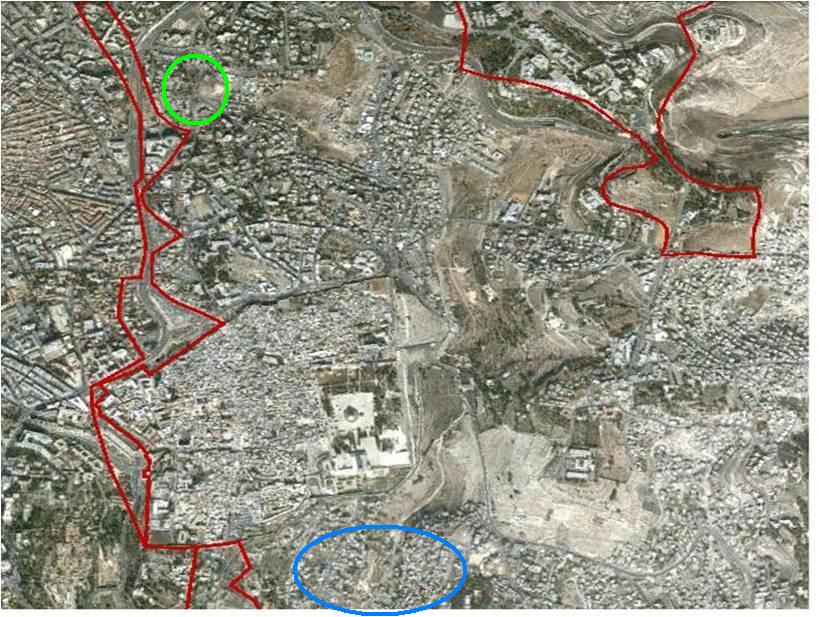
I've marked two significant points. To the north is the Atarot airstrip (circled in light blue), and down to the right, the Holy Basin. Each plays a different role in the story. First, the airstrip.

Between 1949 and 1967 West Jerusalem was the capital of Israel, and it grew significantly. East Jerusalem wasn't the capital of anything, and didn't grow. In June 1967 when Israel took over the entire town, the Jordanian "half" of it was a small area, almost completely inside the yellow frame. To the north, well outside town, was a small airstrip, near where there had been a Jewish village of Atarot until it was conquered by the Jordanians in 1948. In June 1967 a team of three Israeli generals - Uzi Narkis, Shlomo Lahat, and retired general Moshe Dayan - were told to draw a new municipal line. They felt the airstrip had to be inside it, and so they invented a new definition of the city which had no history and not very much logic.(Source for the map) This artificial town had a population of about 250,000, 70,000 of them Palestinians from the Jordanian side, many of whom did not know they were in Jerusalem until the Israelis told them. Had you asked them they'd have said they lived in Um Tuba, or Kfar Akeb, and so on. Israel then proceeded to annex the area inside the line, to offer citizenship to it's populace (they mostly didn't take it), and to "force" upon them the benefits of permanent residents such social security and later universal health care, when we all got it. (Those they did take).

Since 1967 the city has roughly trebled in size, to about 800,000, of them some 250,000 Palestinians. The Palestinians spread out from their villages, some of which connected to each other and to the center. The Jews spread out in the west, and added 10 new neighborhoods in the new areas beyond the old border. Nine of them appear on the above map, and one (Ramat Shlomo), the most recent, doesn't. They are, north to south: Neve Yaakov, Pisgat Zeev, Ramot, Ramat Shlomo, Ramat Eshkol (including Sanhedria), French Hill, the Jewish Qurter of the Old City, East Talpiot, Gilo, and Har Homa. There's also an industrial area of mostly Jewish-owned companies way to the north, next to the airstrip, but no-one lives there. The airstrip, by the way, is defunct. So much for that miscalculation.

The historical heart of Jerusalem is called the Holy Basin. It's a new name, which first entered the political discussion in the Camp David discussions of summer 2000: Ehud Barak was willing to consider handing over the outer Palestinian neighborhoods, the Um Tubas and the Kfar Akebs which probably should never have been defined as Jerusalem in the first place, but was loth to divide the truly historical heart of Jerusalem. There is no official definition of what precisely fits into the Holy Basin, but it's more or less the area between Mount Scopus to the north and the Hill of Evil Council to the south, or perhaps less, depending upon whom you ask. (The Hill of Evil Council, by the way, is a New Testament name, upon which the British built their government house, and the UN sits until this very day. I spoof you not).The center of the Holy Basin is the Old City, which actually isn't the oldest part of town. To it's north I've marked the Sheikh Jarrah area, and to its south I've marked the City of David-Silwan area - which is the oldest part of the city, predating the wrongly named Old City by about 2,000 years.
I've marked five sections of the Old City. Green for the Muslim Quarter, red for the Christian Quarter, blue for the Armenian Quarter, fuchsia for the Jewish Quarter, and yellow for the Temple Mount, called Haram el-Shariff by the Muslims. Jerusalem not being New York, the resolution offered by Google Earth becomes less helpful when you get closer than this altitude above the city, but maybe in a future post, when I try to show the silliness of dividing the city, I'll try none-the-less.

Proposed borders: Jerusalem hasn't been divided, nor has anyone ever officially agreed on how to divide it. Yet since 2000 there has been much discussion of such a division, and of course a total international consensus that it must happen (except for those who disagree). For the purpose of my future posts on the matter, in which I shall try to show why the city cannot feasibly be divided, I'm following the contours of this international consensus. Its principles were formulated by President Bill Clinton on Dec. 24th 2000, and they're very simple: areas where Jews live in will be in Israel, areas where Palestinians live in will be in Palestine. The Temple Mount-Haram elSharif will be in Palestine because the Palestinians really really want it and there are mosques on it. Where possible - open areas, for example - the border will be the Green line of 1949-67.

The folks who agreed on the Geneva Initiative have gone to a lot of effort to make detailed maps of the various sections of town and who they'll belong to; compare their polished output to my slap-dash ones and you'll be impressed, I assure you. The whole 10-piece series is here. Their lines are pretty much what Clinton had in mind, and I expect his wife and her boss agree. So my task in the coming posts will be to show what the reality will look like, and why you wouldn't want anyone you know to have to live in it.

Next chapter: The nine logical outcomes of dividing Jerusalem

The Jews ARE to Blame for the Volcano, After All

Don't say you didn't see this coming. Judeosphere has the story.

Fred Halliday, 1946-2010

Fred Halliday died yesterday, and I first heard of his existence, via Normblog, today. The Guardian has an obituary, which as you'd expect casts Halliday as one of them, in the negative meaning of the term. Yet Norm is more serious than the Guardian, and if he's mourning the passing of an important scholar, I decided to look a bit further. It took only a few minutes to find this list of articles he's written in recent years. David Hartman taught me many years ago that the best way to show respect for the passing of a scholar is to read something he or she has written (this was on the death of Gershom Scholem), so I picked two of Halliday's articles from the list. This one, about Palestine Tibet and other entities that did or didn't attain statehood, and this one in which he reported his thoughts on a visit to Auschwitz.

The articles demonstrate a breadth and depth of knowledge which are mostly lacking in public discourse. More important, they express an ideological commitment tempered by rational investigation. I get the feeling that he and I might have disagreed on some rather important matters in the areas where our expertize overlapped (he knew about lots of things I don't, and I know about some things he didn't). Yet we would have been able to disagree on rational grounds; indeed, we'd have been able to explain to each other in calm tones where our differences came from, and we'd each have come away from the discussion at least with an intellectual acceptance of the sources of the other fellow's positions. We could have had a rational discussion, in short.

Not something to take for granted, unfortunately. So may he rest in peace, but his intellectual example continue to reverberate.

Monday, April 26, 2010

More on American Judaism in Israel and Why Not

There's an interesting conversation going on (if I say so myself) about Reform and Conservative Judaism in Israel, and why it isn't much to write home about, in the comments thread of my previous post on the topic. So rather than cut and paste, I'm informing you: if the theme interests you, you can go back here, and read the comments...

Sunday, April 25, 2010

James Traub Reads the Goldstone Report

James Traub at Current Affairs has read the Goldstone report. He deals mostly with the questions of how a democracy defends itself against an enemy accepts no rules, and is even willing - fleetingly - to consider if the rules as they currently stand may not be unreasonable. My reading was far more critical than his, but if his were the accepted wisdom, I could live with it.

Oops! Fixed the link, I hope, and thank you to Silke for noticing.

Guardians of the iPad

Last week the Guardian reported that Israel was banning imports of the iPad and confiscating them at the airport.

Was this news worthy of publication in the Guardian? Well, mit-a-kvetch, at best. One way of testing the editorial sincerity was always going to be if they also noted the revoking of the ban.

It has now been revoked, about a week later (and remember that Monday of the week was half a workday, and Tuesday not at all). The Washington Post knows that the tests were positive and the ban was lifted. The Guardian doesn't yet know. Perhaps it got blocked in the post-volcanic turmoil, and tomorrow or next year they'll fix their earlier report. Or not. It depends.

Religious Freedom in Israel

A reader who calls herself Laura SF left this comment on an earlier post
My husband & I talk about it from time to time, usually in the context of "If the U.S. starts turning seriously antisemitic..." Until there is real freedom of religion for Jews in Israel, I can't see any sizable number of American Jews moving there for any reason. It's not "easier to be a Jew" there unless by that you mean haredi or identified-but-secular. And don't get me started about the "who is a Jew" madness... (my italics)
Let's see if we can unravel this a bit.

Laura is referring to the limitations on Reform and Conservative Judaism in Israel, of course. Yet what are they, in reality, why are they there, and what might be done about it?

There are no limitations on religious behavior, of course. It's a free country and people can believe in whatever they wish. Moreover, they can organize to believe in the public sphere, too. Within short walking distance of where I sit right now there is a Reform synagogue, two or three Conservative ones, and a handful of experimental ones which play on the edges of Conservative and Modern Orthodox, if you're using American terminology. There are also a couple of Haredi yeshivas, three churches, and if you're willing to walk twenty minutes there are lots of mosques, of course. There are dozens of orthodox synagogues of all hues and colors, a convent - and of course, lots of secular folks who never visit any of these institutions. There's an Arab family who recently moved into our building, but that's a different subject.

As I write I can hear the bells of a church: it's Sunday morning, mind.

All in all, it's as free and open a place as any.

The issues Laura is referring to exist, of course, but they're limited to the legal status of rabbis. For reasons I'm not going to get into this morning, marriages in Israel must be religious (Jewish Muslim Druze or Christian), though civil marriages performed elsewhere are recognized, and civil unions have legal standing as marriages for just about all purposes. The implications are that only orthodox rabbis may officiate at weddings, and people with no Jewish grandparents who wish to move to Israel under the Law of Return must have been converted by an orthodox rabbi. (Or use a loophole, of which there are a number). (Or come in on the refuge track, or as cheap labor and then have children and stay...)

So to be clear the real question isn't who's a Jew, but who's a rabbi. On that one the honest answer is that Orthodox rabbis of all hues are recognized, and the others: not. Or mostly not. I recently celebrated at a wedding officiated at by an American-trained Conservative rabbi. I didn't ask which loophole he used.

Why is this so? Because of democracy. There used to be a very large majority of Israeli Jews who instinctively defined a rabbi by the orthodox terms, even though many of them were secular. Secular Israeli Jews accepted the orthodox definitions; as the joke went: the synagogue they didn't go to was always orthodox. Back in the days when the rules were legislated, there was next to no constituency in Israel for Reform or Conservative Judaism.

Over time this has been slowly changing. There's a chain of schools - Tali, it's called - which is pretty recognizably Conservative. Rabbi Ehud Bender, the top Conservative rabbi, is a public figure whom the media, at least, treats as a rabbi. Non-orthodox representatives sit on the municipal panels that deal with matters such as Kashrut. Yet it's slow going, for the simple reason that the orthodox rabbis are entrenched in the institutions, and dislodging them or even simply adding others alongside them takes political action. In a democracy, political action succeeds when enough people want it to. If the orthodox don't want change, and the secular are fine with the orthodox rabbis so long as they don't interfere in their own lives, who's going to force through change? It will have to be newcomers.

The Russians wish to change some things, which is an important motivation to vote for Lieberman's Yisrael Beitainu party - but he's got only 12% of the vote, which is far from a majority. Meretz used to be in favor of such changes, but their insistence on disconnecting from reality on more important matters has eroded their representation down to almost nothing.

The bottom line, Laura, is that you've got it backwards. Were 500,000 Reform or Conservative Jews to move to Israel, learn the ropes, and set out to change the way Israel does these things, they'd be joined by a reasonable number of people who are already here, and they'd have their change or at least a compromise that everyone could live with- and Israel would be a stronger place for their being here. Sitting far away and kvetching about things from the sidelines isn't going to help.

The neighborhood I live in is proof: it has an unusually high concentration of former Americans - and look at all the options on offer.

A final comment: I have gone to services at the nearby Reform synagogue three or four times in recent years. Each time I go I'm struck anew by the degree to which they aren't that different from the other synagogues all around them, but they are different from Reform or Conservative places I've gone to in the US. The difference is because of Hebrew. The moment the service is in Hebrew, and therefore it's point of departure is the traditional service and prayerbook, it fits onto the continuum of what Orthodox synagogues do. Perhaps it's just off the edge of the continuum, but recognizably so. This, compared to services I've seen in some American places which I was hard put to recognize.

PS. The wrong rabbis are taking control of the Western Wall. This is a real problem - but it's the result of the fact that all the rest of us let it happen.

Update: Barry corrects me. The Conservative rabbi is Ehud Bendel, not Bender, but he has moved elsewhere. I expect the most obvious person who now occupies the same social-political position is Uri Regev, a Reform rabbi.